
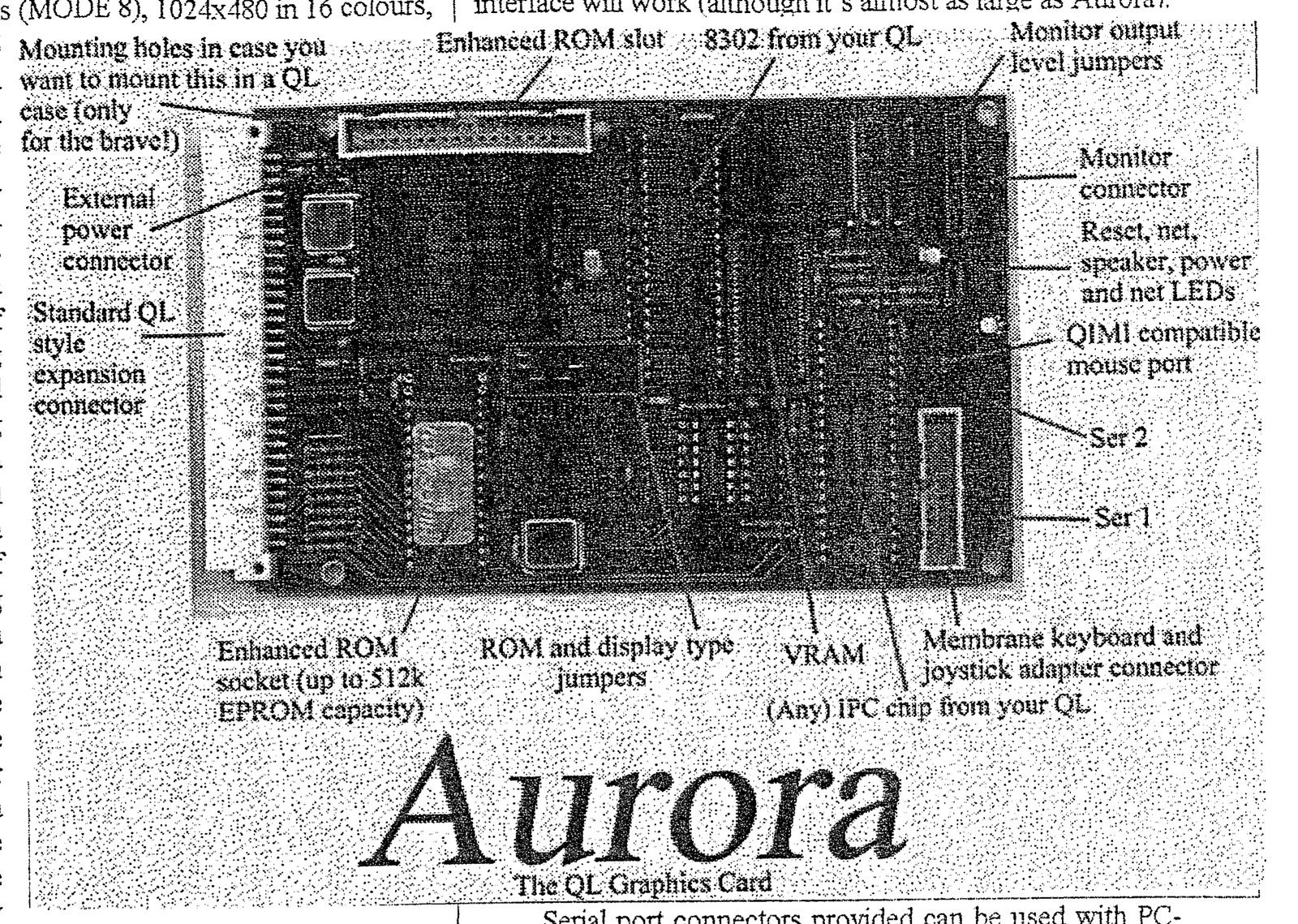
The Aurora is a replacement QL motherboard and a graphics card, all in one product. It is intended to be used in boxed QL’s with PC power supplies, but can also (with some work) be mounted into a standard QL casing (this involves soldering, though, and should be undertaken only by people who know what they are doing!!!).
The Aurora requires the user to pull out the 8302 ULA and any kind of IPC (and/or keyboard interface) from their existing QL setups and plug those chips into the Aurora. We can also supply Aurora with 8302 and/or IPC of your choice for an additional price.
Features
Can use old QL and VGA, SVGA or midrange multisynch monitors, displaying various maximum resolutions (depending on the monitor). Output levels can be set using jumpers on the board to acomodate monochrome, TTL RGB, analogue RGB or TTL-level analogue RGB (Microvitec CUB) monitors. Depending on the monitor type various connector adapters may be needed – the board is delivered with a VGA 15-pin mini-D connector adapter (as used with VGA/SVGA and most multisynch monitors)
Maximum resolution is 1024×768 in 4 colours (MODE 4), 512×768 in 8 colours (MODE 8), 1024×480 in 16 colours, 512×480 in 256 colours. The actual maximum resolution displayed may be lower depending on the monitor type. In particular, old QL monitors will display a maximum of 1024×288 if interlacing is disabled, and 1024×576 if interlacing is enabled. VGA and SVGA monitors will also display a maximum of 1024×576 if interlacing is disabled. Refresh frequencies have been optimised to the highest permissible rate on the monitor selected. The Aurora will in any case automatically limit the size of the display depending on both monitor and Aurora’s limits. Interlace enabling is left to the user (this can affect resolutions displayed) – interlaced displays will not be of high quality on QL monitors, this being the fault of the monitor itself.
Resolution is selected on the basis of 4 horisontal resolutions: 512, 640, 768 and 1024 pixels. In addition, for any of the 4, one of two aspect ratios can be selected – 2:1, common to QL displays, where the number of pixels in the vertical direction is half of that in the horisontal (512×256, 640×320, 768×384, 1024×512), and 4:3, common to QXL, QPC and QVME users (512×384, 640×480, 768×576, 1024×768).
Modes are selected separate of resolution. Mode 4, and the new modes with 16 and 256 colours are provided. Mode 8 is also provided for compatibility, and will display half the pixels in the horisontal direction with respect to mode 4, just as a QXL would. As on the QXL, flashing in mode 8 is ignored, but the data for it is retained for compatibility reasons.
Programs accessing the original screen area will display a picture in the top lefthand corner, regardless of resolution selected, as long as the screen is in mode 4 or 8.
Please note that in order to use the higher resolutions and more colours, a Super Gold Card is required. The card can be used with a Gold Card as well. The ability to use VGA/SVGA or multisynch monitors is NOT affected by the use of SGC or GC – this will work with both.
Will accept any IPC on the market (superHermes is highly recommended, there is a special superHermes jumper which relieves you from using the superHermes flying lead) and any PC keyboard interface – with some riser-sockets (available on request) even the Falkenberg interface will work (although it’s almost as large as Aurora).
Serial port connectors provided can be used with PC-style connectors (as used on PC IO cards), using simple flat cable with press-on connector adapters (IDC10 to D9). Ports use the standard PC wiring so you can use standard PC cables you can cheaply buy in computer shops.
On-board QIMI compatible mouse interface is provided for QIMI users, as the original QIMI interface cannot fit onto the board because of the size).
Enhanced ROM socket can accept QL ROMS (both stacked onto each other, piggyback), Minerva (any version) or an EPROM (including the Minerva EPROM without the Minerva PCB), 64, 128, 256 and 512k sizes are supported, with the OS automatically recognised in the first 48k. We are currently working on extensions which will enable loading of programs from the EPROM if a larger size EPROM is used. Type of chip used in the ROM socket is selected by jumpers.
Enhanced ROM slot can be used with existing ROM slot peripherals (by use of a small adapter cable). For tinkerers, additional lines are supplied – R/W, RESET, EXTINT and a special select line which decodes the unused part of the QLs IO area (15.5k total space).
Membrane keyboard and mouse connectors have been replaced by a 20-pin header. This can be used for applications which need only a few keys, or with an adapter (11 diodes and some cable – total cost about 5 Pounds) the QL membrane keyboard can be connected.
The board is powered from 5V power, we suggest using a QPlane for this (an easy, no-solder solution). In case of fitting into a QL case, a separate connector is used to connect a +5, +12 and -12 (and optional +9V) power supply, which the user has to provide.
PC case compatible header is provided for a reset switch, power LED, speaker, and network LED (we use the PC case Turbo led for this!). A simple cable adapter will connect standard QL net ports to this header as well.
There are NO microdrives and NO TV modulator!!
DRIVERS
Immediate high resolution support is available for SMSQ/E users, in modes 4 and 8, by applying a patch to SMSQ/E. 16 and 256 colour drivers will be available in the future (see below!)
LAST MINUTE NEWS
Tony Tebby is currently working on extended screen drivers which will allow more colours to be used on QXLs and QPCs, and possibly other SMSQ/E systems. We are taking steps to insure that they will work on the Aurora too!
The card will be available in 4 to 5 weeks from Qubbesoft PD, for 120 UK Pounds, plus postage and packing, user manual, SMSQ/E patch software and utilities, and VGA lead included.
FUTURE PRODUCTS
We intend on producing a successor to the Super Gold Card, again we haven’t thought of a name for it yet but it might be called ‘The Gold Fire’. The project name we have given it is ‘The Super Duper Gold Card’, this doesn’t mean it is going to be called this when we release it for resale. Early specifications are as follows:-
Upto 64Mb of RAM using a 72 pin SIMM, options being 1,2,4,8,16,32 or 64MB. A Bi-directional Parrallel port enabling connection of back-up devices etc. An I2C port similar to the one on Minerva.
Other items that we are looking into producing are an ETHERNET Card for the QL, which will speed up the QL -> QL Network. A FLASH EPROM card that can be programmed and re-programmed from software.
If their is anything that you feel the QL is lacking, hardware wise that is, please let us know and we will try our best to look into it and see if it’s possible. For further information on any of the products we carry for the Sinclair QL please contact us at the address below:-
QUBBESOFT P/D
38, BRUNWIN ROAD
RAYNE, BRAINTREE
ESSEX. CM7 5BU
UK
TEL: +44 (0)1376 347852
FAX: +44 (0)1376 331267