
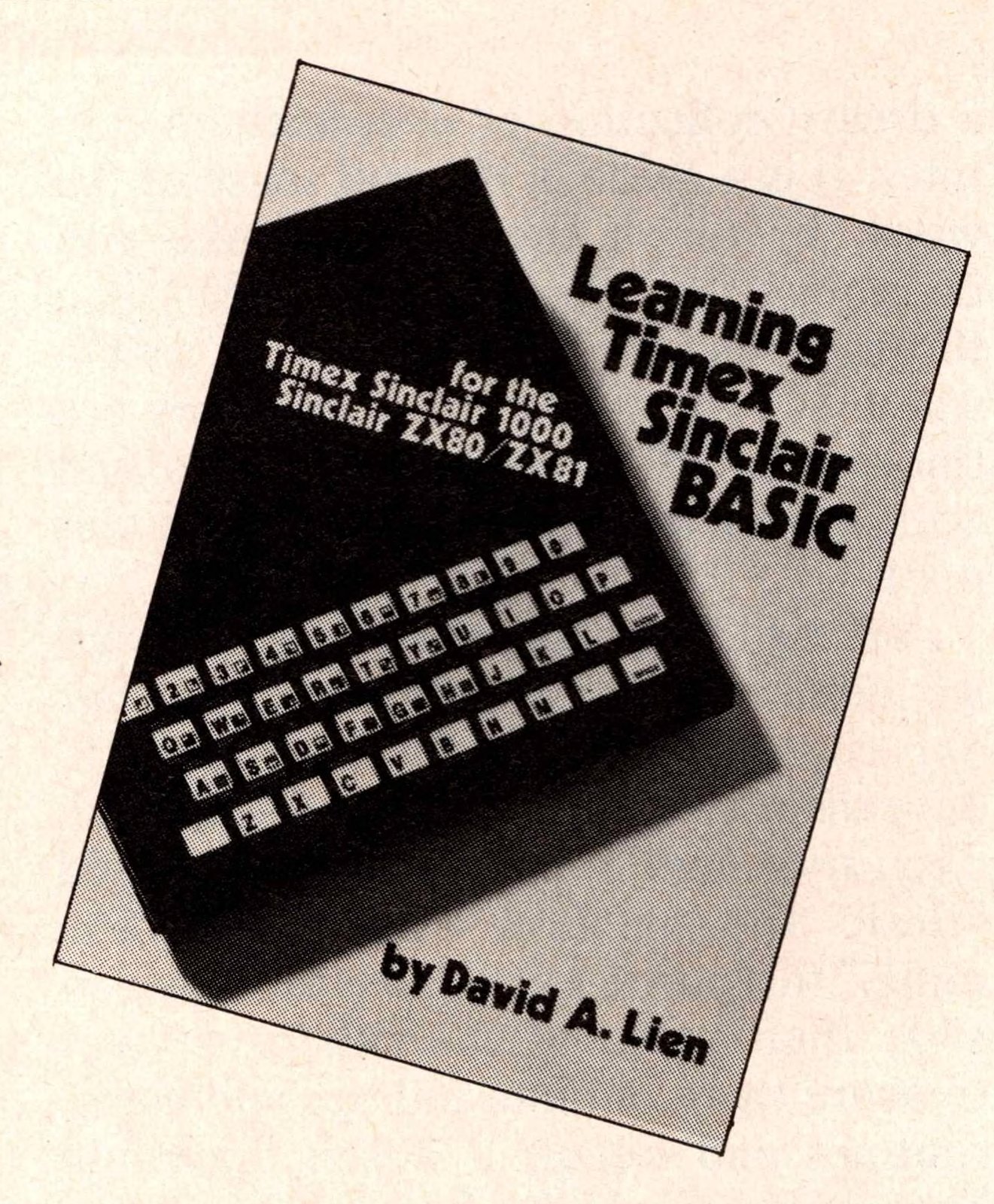
Learning Timex Sinclair Basic by David A. Lien. Compusoft Publishing. $14.95.
If you have ever thrown down your TS1000 User Manual in despair—or disgust, help has finally arrived: David Lien’s Learning Timex Sinclair Basic. It is a clear, thorough guide to programming the Timex Sinclair 1000, but ZX81 and ZX80 users are not ignored. No matter how “learner friendly” the manual for the new TS1500 will be, it could not be friendlier than this.
Lien takes the reader from plugging in the computer and doing a first PRINT command to writing search and sort routines and using PEEK and POKE. A sample program illustrates every new concept, and many of them are revised in the light of new materials presented—a very effective explanatory method.
Computer novices are always assured that a strong math background is not necessary for programming. Regardless of its necessity, a thorough grasp of mathematical principles is certainly desirable. Lien has given the best no-frills explanations of logarithms, exponents, and the trigonometric functions that I have seen. If you learn about arrays from this book, you will wonder why the array is considered so difficult by some.
The string functions are covered over several chapters; various concepts are introduced so slyly—I mean, slowly—that the reader can easily follow the development of an alphabetical sorting routine.
The chapters on video display graphics develop a simple shoot ’em-down arcade game that will give you a basic understanding and a new respect for the programming that goes into the real thing.
All the fundamentals of Sinclair Basic are covered in what the author notes is a “light and non-threatening” style—so light, in fact, that he occasionally gets carried away, leaving one wishing for something more substantive, e.g., regarding the screech on the tape: “You expected maybe Lawrence Welk?” or, regarding the rate/time/distance formula: “If it’s been a few years, you might want to sit on the end of a log and contemplate that for a while.” The misplaced cuteness is easily forgiven, considering the contents of the text and its otherwise excellent presentation.
The author notes that this book is based on the best of his earlier writings. This accounts for its quality and also its most serious flaw—serious in terms of the magnitude of the error, not in terms of the overall presentation. The chapter on “Debugging Programs” has not been thoroughly revised to suit the ZX/TS computers. He lists some common errors to check for if your program is not running correctly. Included here are a half-dozen mistakes that the ZX/TS syntax checker never lets you enter to begin with, and it will even show you where the error is when you attempt to enter the line, e.g., forgotten end quotation marks in a PRINT statement, using an out-of-range line number.
There are exercises sprinkled liberally throughout the book, with sample answers given at the end. Information is presented in small doses, in logical sequence, and in a light manner. You may find yourself wishing for a little more information in a particular area, such as how to PLOT a circle, other PEEK and POKE routines, or more moving graphics methods.
However, it was not Lien’s intention to teach everything about some things, but something about everything, and he manages to do just that. It is hard to imagine anyone working through this book page by page and not acquiring a thorough understanding of ZX/TS programming techniques. It seems an ideal how-to book for teenagers as well as adults.