
As we grow older, memories of our first computer or our first experience with computers is one thing we won’t forget. “Son, when I was your age, we didn’t even have an abacus and ……”
My introduction to computers came some 26 years ago. IBM TimeShare terminal. BASICA it was, one cryptic manual written by nerds for nerds was all you got after a two-hour informative guided tour of the IBM building in downtown Chicago. What I still vividly remember to this day is that five-foot wide by five-foot tall printing machine printer that rolled out yards and yards of four-foot wide paper of nothing but 10010101001100101001 … that I still wonder how it was deciphered by the attending wizards. I believe it was a 4-bit system and they counted from the left by fours — 4 digits. We, about 20 strong, were not escorted into the computer hall, as our bodies might have had upset the temperature and the humidity balance of the clean room environment. But we peeked through the large glass windows at those Big Blue steel cabinets.
“You guys should be able to figure it out for yourselves. You can call us if you need help”; We were told. And calls we did at first. Most of us never had a course in “Binary Logic” at school, most colleges and U’s did not offer such a course in those days.
We, engineers, used to huddle around the terminal during lunch hour and sometimes after hours to try and understand the LOGIC of it all, after we diligently made confetti out of the manuals.
A for-instance. It took an engineer about three hours to design a calibration spring for a control using a Friden desk calculator.
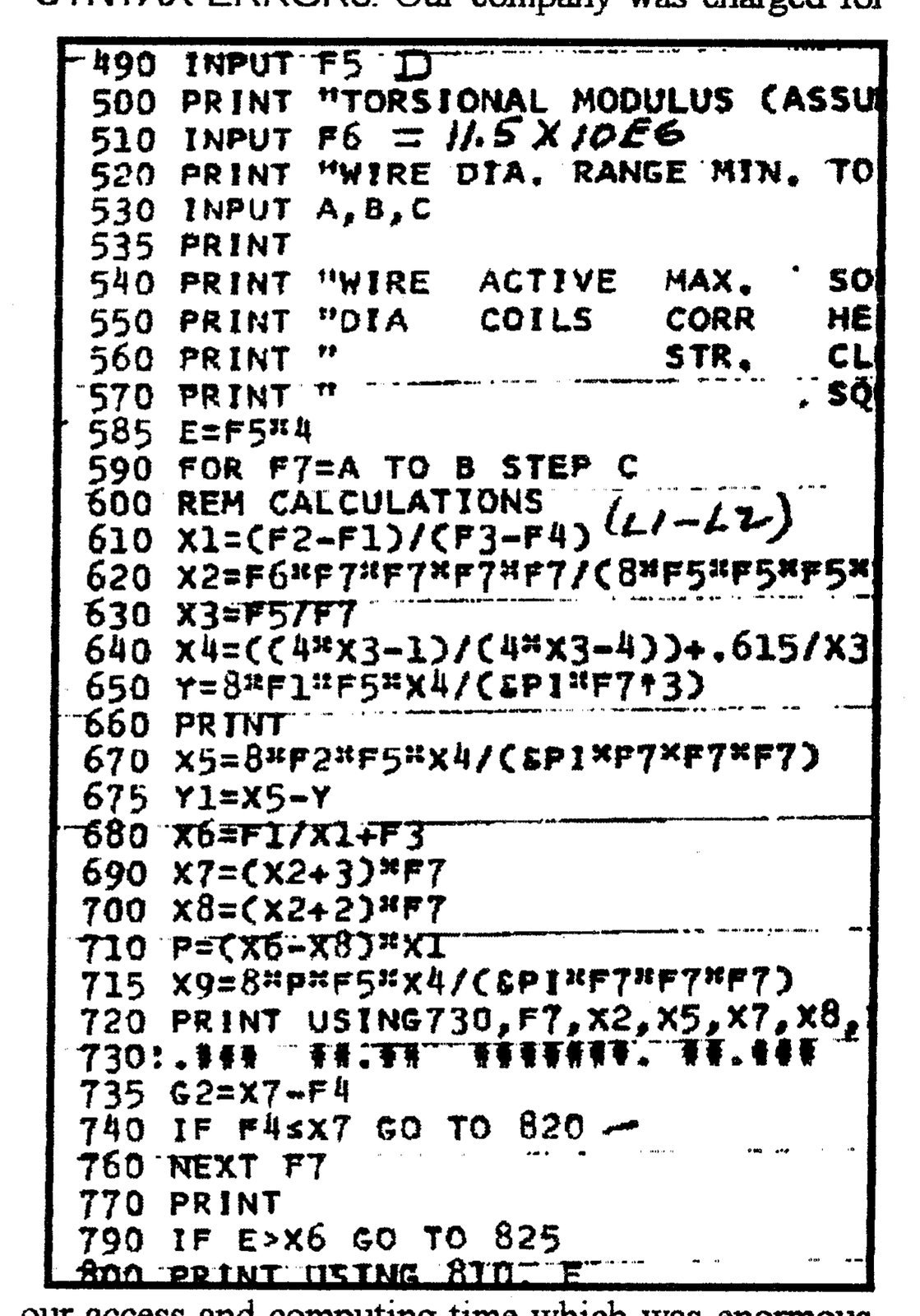
After a few months of wrestling with BASICA Syntax Errors — demonstrating our ignorance — another engineer and myself came up with a program, our first attempt at BASIC, that did the design work in about three minutes, provided that the terminal was not being shared at the time of course. There were only four arithmetic functions +-×÷ , no square root, exponents only to the 3rd power (see line 620) and no π — it had to be defined along with any other constant you had to use, no sine, cosine etc.. I completely forgot how one engineer was able to do square roots √. I should know how, I had it in grammar school.
We discovered that a computer was a marvelous tool for iteration – repeating tasks.
The program was entered on a TTY (teletype) and the output was received on a TTY — monitors were unheard off. But we did see one engineer experimenting with a television set with 0s and 1s on the screen at IBM. You dialed-in using an acoustic modem (27 or was it 30 BAUD) and hoped that the downtown computer – the only one in Chicago – was not tied up and that you didn’t have, you guessed it, SYNTAX ERRORs. Our company was charged for our access and computing time which was enormous at the beginning. In fact, the bean counters threatened to cut-us off. But, Hey! Ma — 3 minutes instead of three hours!
490 INPUT F5
500 PRINT "TORSIONAL MODULUS (ASSU
510 INPUT F6
520 PRINT "WIRE DIA. RANGE MIN. TO
530 INPUT A,B,C
535 PRINT
540 PRINT "WIRE   ACTIVE   MAX.    SO
550 PRINT "DIA    COILS    CORR    HE
560 PRINT "                STR.    CL
570 PRINT "------------------------- . SQ
585 E=F5*4
590 FOR F7=A TO B STEP C
600 REM CALCULATIONS
610 X1=(F2-F1)/(F3-F4)
620 X2=F6*F7*F7*F7*F7/(8*F5*F5*F5*
630 X3=F5/F7
640 X4=((4*X3-1)/(4*X3-4))+.615/X3
650 Y=8*F1*F5*X4/(&PI*F7↑3)
660 PRINT
670 X5=8*F2*F5*X4/(&PI*F7*F7*F7)
675 Y1=X5-Y
680 X6=F1/X1+F3
690 X7=(X2+3)*F7
700 X8=(X2+2)*F7
710 P=(X6-X8)*X1
715 X9=8*P*F5*X4/(&PI*F7*F7*F7)
720 PRINT USING730,F7,X2,X5,X7,X8,
730:.###  ##.##  #######. ##.###
735 G2=X7-F4
740 IF F4≤X7 GO TO 820
760 NEXT F7
770 PRINT
790 IF E>X6 GO TO 825
800 PRINT USING 810, E
Apple/Orange π
Have you seen a π key on a keyboard lately? In fact all mathematical functions are in the software and not in the operating system. So what difference does it make? It makes life much easier to turn on the computer and start punching away instead of waiting to load a spreadsheet or an AutoCad that takes a long time to learn. After you just begin to learn how to use it, you start discovering its quirks and then you have to learn how to go around them and all you want to do is balance your check book.
Being an amateur programmer who likes to keep up with the state-of-the-art when I can afford it, I found out that every system had its idiosyncrasies that you had to learn how to live-with in the platform of your choice. There is absolutely no excuse for operating systems maligning the user just for the sake of being different from other operating systems. Those that did are gone and forgotten. Then there were those that did an excellent job but couldn’t hack the business end of it, such as Commodore who went bankrupt.
May 14, 1995
Escom AG, who operates 1500 computer stores in Europe, paid $10 million for the rights to the Commodore name, its patents and intellectual property in bankruptcy-court action. It plans to resume production of Amiga model in China. It says it will integrate Amiga technology into MSDOS software format used on 80% of the world PCs. Escom has no plans to use any of the former production facilities.
C:> a: I really meant flp b:
Abort? Retry? Fail? Abort
Abort? Retry? Fail? Fail
Current drive is no longer valid> 
Abort? Retry? Fail? ȝΨ Ωωφη why not take me back to where I started from? ξΞϖκφϒ. Bill Gates; this is 1995.
In the Logical world of computers, oh! why-oh-why do programmers drive users bananas with their illogical quirks. To be cute? or to punish you for the mistake you made? You keep going round-and-round and you get those cryptic sarcastic error reports; they just didn’t do their homework well. But things have changed a bit to the better and the error codes are more polite? and mostly informative.
Nonsense in BASIC
The Timex/Sinclair 2068 reported for VAL error, but it took the licking and kept on ticking.