Re-print from ZX-APPEAL
Sinclair’s QL has as standard a 128 K RAM, which sounds like a lot in comparison with most 64 K machines. Unfortunately, the software writers, in the knowledge that there is more than enough memory, have been rather wasteful in their work, so that at the end of the day, there is not all that much more in the QL than in the 64 K machines. So, you need more memory…
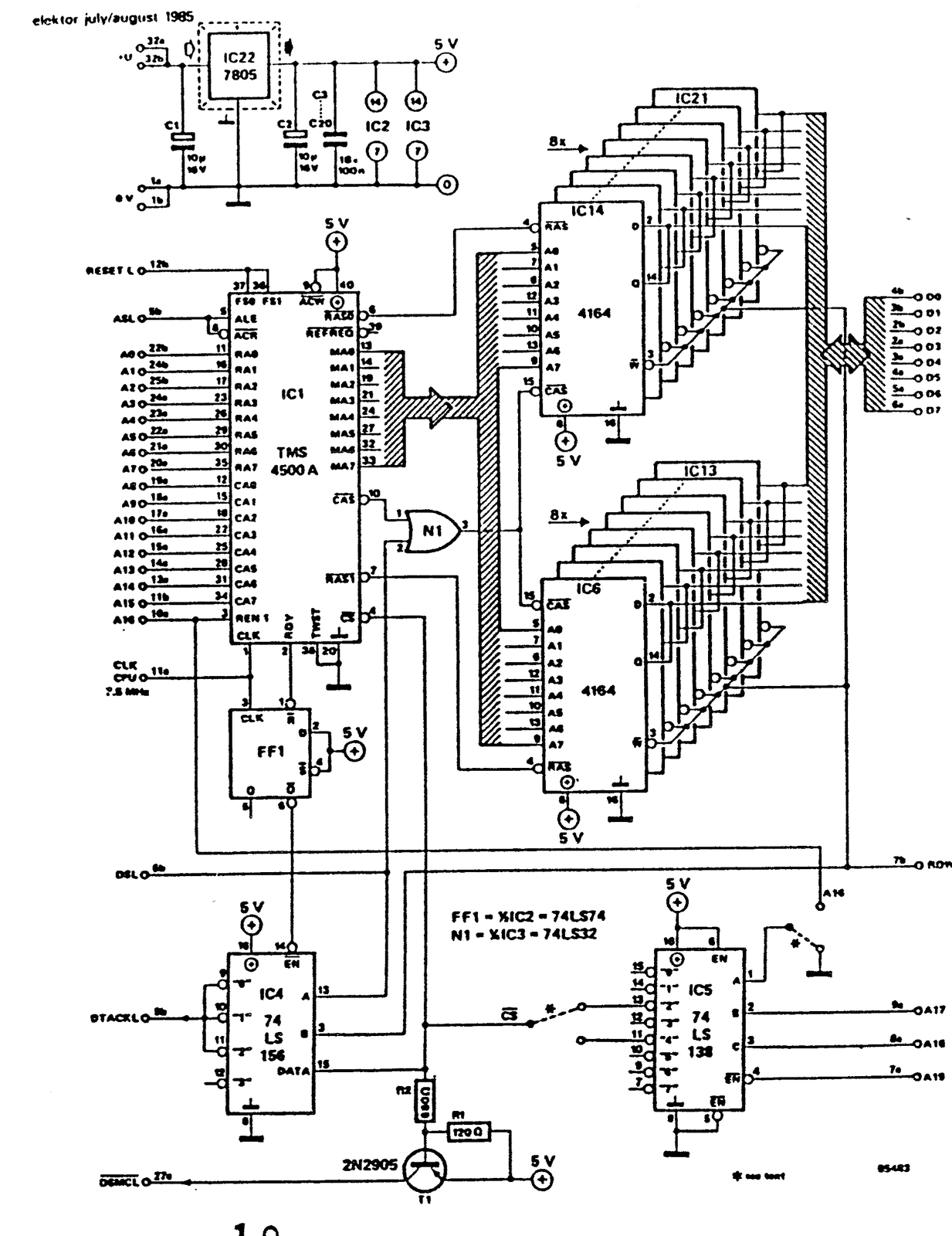
The accompanying circuit is an application of the TMS4500A as RAM extension for the 68008. This chip can drive a maximum of 128 K dynamic RAM and provides virtually everything: multiplexing of the address lines, RAS, CAS, and REFRESH.
The memory ICs are 64 K x 1 (128 or 256 refresh are both permitted) and have a speed of better than 150 ns. Since the QL uses a clock frequency of 7.5 MHz rather than the normal 8 MHz, such a RAM can run without wait cycles. An 8 MHz CPU that regularly has to carry out a wait cycle is appreciably slower than a 7.5 MHz type!
The 68000 family is provided with a data acknowledge input. As with other processors, the CPU places addresses and data onto the bus and indicates the validity with an address strobe and data strobe respectively. It continues to do so until the memory sends a DTACK signal. The present extension generates this signal with the aid of the LS156. Normally, this acknowledgment is given almost immediately, but it may happen that the 4500 is in the middle of a refresh. In that case, the CPU has to wait, which is arranged via the ready output (pin 2).
To prevent the QL waiting forever when an address is read that has no memory, the DTACK is generated internally: this must, however, be disabled for addresses where the RAM extension is located, and fortunately this can be done easily via DSMC. By making this logic high as quickly as possible, the internal DTACK is cancelled.
If you cannot get the 2N2905 transistor, you may use a BS250, in which case resistor R1 can be omitted and R2 should be replaced by a wire link. The circuit as shown is for the 128 K version. It is also possible to omit the eight RAMs connected to RAS1 and make a 64 K extension. Input A of the LS138 must then be connected to A16 and pin 11 instead of pin 13 must be used as CS.
There is no 5 V supply available on the connector, but there is a 9 V line. This can be reduced to 5 V by a standard 7805. The current drawn depends on the types of RAM and will be 200…300 mA. It is important to decouple the supply lines properly: each RAM IC and the 4500 require a 100 n capacitor!