
From the March 1983 issue of Computers and Electronics Magazine
This past weekend I set aside the time to go through my collection of old computer and electronic magazines. Most of them were from the early 1980s, and were bought because of their Timex-Sinclair articles and other electronic projects.
The following information can be found in the March 1983 issue of Computers and Electronics magazine in an article by Les Solomon entitled “Adding a Video Monitor to your Sinclair ZX81”. As Mr. Solomon points out, the modification below can be made by adding a small piece of thin coax cable to the video out wire on the RF Modulator module (see figure above).
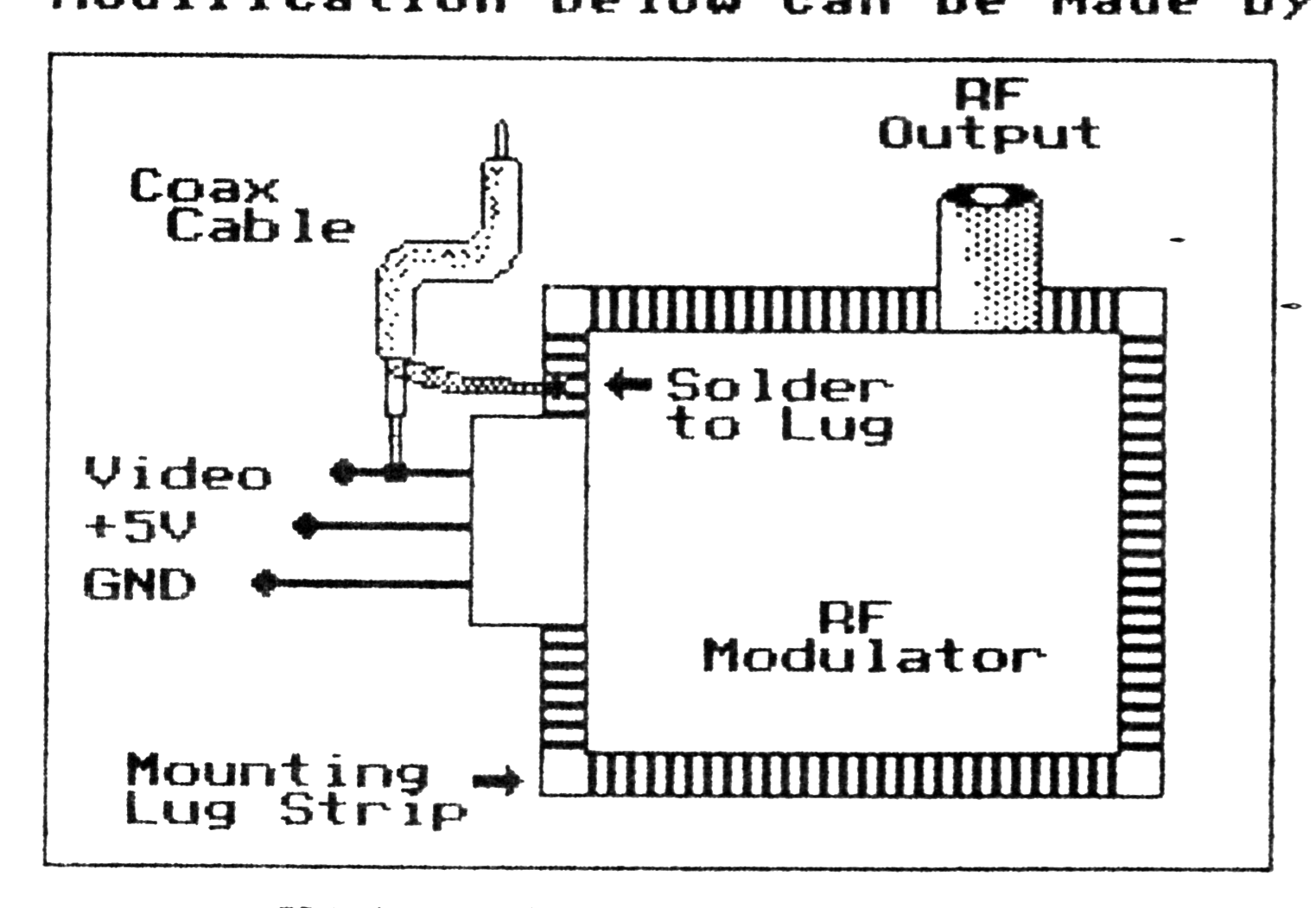
The center lead of the coax cable is soldered to the Video wire, and the braided sheilding wire is pulled away and soldered to the mounting lug strip for grounding (see figure).
The other end of the coax cable should contain an RCA connector which is used to plug into the back of a composite monitor.
Mr. Solomon recommends when attaching the braid to the metal enclosure, “…the bottom grips can be used as the enclosure is solder-proof aluminum.”
A better way to add a composite video output is to use a short piece of coax cable attached to a female RCA connector. This connector can be added to the back of the ZX81 or TS1000 by cutting a small hole in the back of the computer and mounting the connector through it. After that, all that is needed is a cable like the one used to go between the TV output and the Game/TV switch box.
Additional Timex-Sinclair Video Project Information
Another project regarding TS1000 and ZX81 appeared in Computer and Electronics May 1983 issue. The article was written by Steve Pence and it covered modifications to provide direct video output and white-on-black display.
The project involves building a circuit which includes a buffer amplifier, a comparator (to separare the sync pulses), and additional circuitry for providing a composite and inverse video output. There is also a switch which allows the user to flop between inverse and standard video output.
The article is well written and contains a parts list, a schematic, a wave-form figure, a foil pattern for making the printed circuit board, and the componant layout.
Mr. Pence wraps up his article with a diagram of the TS1000/ZX81 for installation as well as information on adjusting both the circuit and the users monitor for the best picture.
Both articles are well written and concise. They contain all the information required to make the modification within one issue of the magazine.
I highly recommend anyone with a TS1000/ZX81 to go to their public library and obtain a copy of both articles for their Timex-Sinclair project files.
And Last But Not Least…
If there is anyone out there who still owns a ZX80, there is a nifty little circuit in The Best Of Sync magazine which shows a schematic diagram for directly inverting the video signal of the ZX80, and adding a composite video output signal.
NOTE: ISTUG and this newsletter assume no responsibility for the modifications mentioned above.