
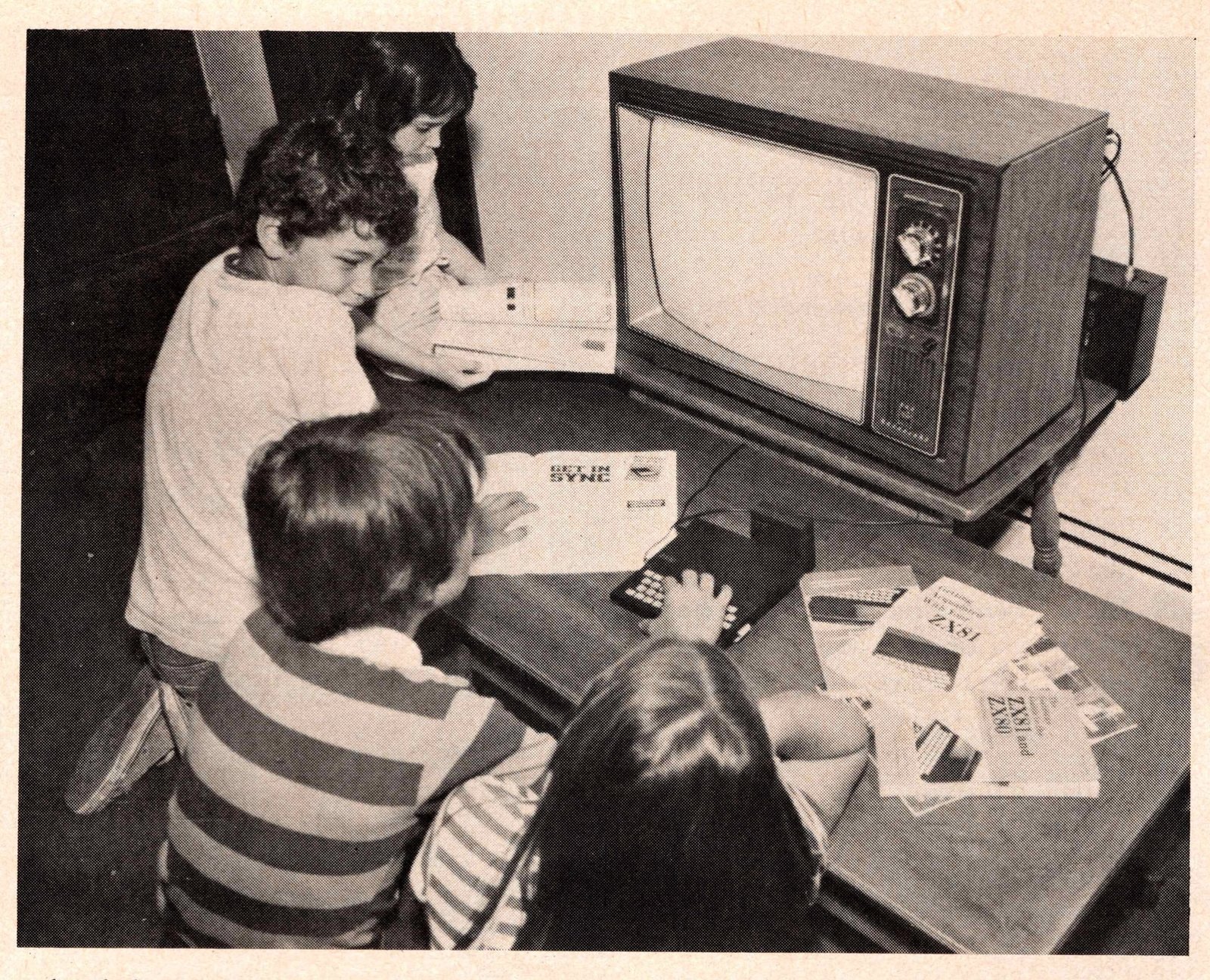
The Educational ZX80/1 Users’ Group (EZUG) had a triple celebration in January. First, we were able to breathe a sigh of relief that we had survived a year of frenzied activity. Secondly, we welcomed the thousandth subscriber to our bimonthly newsletter. Thirdly, we launched our first educational ZX81 programs, fourteen of them in fact. Now, some months later our “membership” has passed 1500, and we have over forty validated and popular ZX81 programs on our list.
I make these points not because I want to plug the group, but to show that in Britain the year-old Sinclair micro is being taken seriously as a teaching resource. This will remain true, for a couple of years at least, despite the appearance of the remarkable Spectrum. While Spectrum and ZX81 programs are not interchangeable, they bear such a close relationship that rapid conversion is straightforward.
Our group’s directory of suppliers to the ZX market currently lists organizations producing educational software for the machine. Also MUSE, Britain’s leading educational computing organization, has given this record-breaking new machine a lot of support. Some support has come from Sinclair Research as well; in particular their educational software awards scheme attracted a great deal of interest.
Although actual data are very hard to come by, there is no doubt that already the ZX81 is by far the most popular micro in British schools. It compares very favorably with the longer-established front runners such as the Apple, the PET, and the Research Machines 380Z/480Z (a stolid, fairly old British microseries), and it is way ahead of the popular but newer BBC machine.
The number of ZX81s in use in British schools by now may exceed 10,000. This is as many as all other micros combined. Such success must be seen against the background of almost universal antagonism by the decision makers in our educational system. “The ZX81 is only a toy” is a common statement from inspectors and advisers; “Forget it,” they say. A senior inspector with a large education authority even publicly stated the following: “If I come across a ZX81 in any of my schools, I’ll stamp on it.” British teachers tend to have a fairly low opinion of their advisers; such attitudes hardly help though I believe they are symptomatic of fear more than of anything else.
In a few areas, the authorities are now considering adopting the ZX81 as the official machine for the primary schools (Grades 1-6). But I know of none which provide much of the support that the teachers need such as courses, advice, software development, and so on.
Yet the ZX81 continues to infiltrate the schools at a breakneck pace, and the teachers are joining the Educational ZX80/1 Users’ Group at a similar pace. The reasons for this are both external and internal. Schools and teachers are under pressure from pupils and parents to provide effective computing facilities and courses. That pressure is mainly linked to the ZX81 since it is by far the most popular micro in British homes.
Areas of Use
How are micros coming to be used in British education? The answer is not just applicable to the Sinclair range, of course, since to some extent at least the ZX81 can attempt anything other micros can do. And the answer is not just applicable to Britain because educational computing in North America is as progressive, successful, and exciting as on this side of the Ditch.
Furthermore, the answer is not just applicable to schools and colleges. The ZX81 is a help with the children’s academic work at home, and many university departments have ZX81s around.
Classroom Uses
We can break the classroom uses down into the following categories.
Computer awareness. The primay aim is to increase familiarity with the computer and its uses. Most schools in Britain now attempt at least a few hours of this with all pupils.
Computer studies. The ZX81 is the apparatus used for formal computer instruction.
Computer-assisted learning. The computer joins the army of resources available for teaching in most subjects.
Other Uses in the School
Other school uses not directly in the classroom include:
Administration. The computer helps the daily routines of the school as it does in any other business.
Interfacing. Again the computer helps as in many other fields with data capture and process control.
Computer clubs. Many schools have thriving clubs in out-of-class time.
Fund raising. A major educational activity in Britain nowadays is the use of computer games for fund raising!
Developing software and hardware. Not a few schools find their facilities used by pupils (and teachers) for developing software and hardware products for sale.
Computer-Assisted Learning
Probably the main educational interest of most teachers and parents with a ZX81 is computer assisted learning (CAL).
McGraw-Hill’s new Devil’s DP Dictionary (which I hope you all get a chance to read!) has this to say:
CAI n. (Computer-Aided Instruction.) The misguided attempt to replace each teacher in the Bronx with 60 on-line terminals. CAL n. (Acronym for CALifornia or, archaic, Computer-Aided Learning.) A superior West Coast (USA) version of CAI in which each teacher is replaced by 25 on-line terminals.
Some people think that in the not too distant future teachers will be replaced by computers. I do not agree, even though micros are far more effective than terminals. Indeed I shudder at the picture of a school in which the children spend all their time connected to a computer, living like chickens in a battery farm. (Impossible future? No! A recent book describes how a computer could check continuously that the user’s eyes are following the screen display!)
At the moment, however, we have hardly taken a couple of steps along the road to such computer systems. The ZX81, like other established micros, can run only fairly simple teaching programs. It will be a long time before the PLATO approach reaches school level!
Such programs are, on the whole, simple mechanizations of the teaching machine material of a couple of decades ago. In most cases they are very crude, with each frame (unit of teaching) being on the lines of those shown in a flowchart such as shown in Figure 1. To program this kind of thing is obviously fairly straightforward (at least, as long as the question requires a very simple “objective” answer). It can be elaborated by adding a scoring feature as shown in Figure 2.


Teaching is not like that though. Programs must therefore progress towards mirroring classroom technique in sophistication, flexibility, and explanation. Thus correct responses require that the user be further checked for understanding; each incorrect response should lead to relevant remedial assistance. The flow chart in Figure 1 rapidly becomes unmanageable and must be replaced with the type in Figure 3.

Thus high expertise, both in programming and in teaching, is needed to produce material with even a little effectiveness. Like most micros, the standard 16K ZX81 despite its efficient use of memory cannot hold more than short programs of this nature. In Britain more and more teachers are turning to larger memories now available for the ZX81 in an attempt to overcome this problem.
Other aspects of teaching programs also require a great deal of attention still. Amazingly, it is common to find spelling and grammatical errors in material designed for use with children. This is inexcusable. Again, there is a skill in formatting the screen display that too few seem to appreciate.
So it is still early to expect the ZX81 to be actually used to teach more than a very few small topics in any course. There will be progress but we must wait a number of years to see much change.
The ZX81 As a Teaching Resource
Meanwhile, viewing the ZX81 as a teaching resource like worksheets and projectors does at least open up other fairly straightforward programming opportunities. Here are the approaches concerned.
1) Computations in geography, economics, maths, the sciences.
2) Development and testing of models in those subjects and for sports.
3) Retrieval of stored data in many subject areas.
4) Representations of data in graphical or tabular form (with or without hard copy).
5) Educational gaming and simulations in social, general, and science subjects.
6) Reinforcement (drill) and testing.
7) Control of laboratory and workshop equipment, and data capture.
Program Availability
In Britain now (early summer) perhaps a hundred adequate 16K ZX81 programs for learning are available. These sources are listed separately below. The vast majority of these are in the “reinforcement and testing” category, but at least a few are found in most of the others. For simple administrative tasks, too, some material has appeared. Of course, each one of those thousands of ZX81s in use in British schools will have available a fair number of unpublished and fairly short routines. Produced by both teachers and pupils, these are intended to meet restricted local objectives or to assist familiarization with the micro. There will be a huge overlap between these, but some will eventually surface in the form of distributed cassettes.
However, for the moment at least, educational software is slow-moving in Britain. Competition is becoming fierce as more companies appear. Yet most suppliers must be content with sales numbering tens a week rather than the hundreds or thousands experienced by the top games providers. The retail distributors are chary of handling educational material, too, as the criteria for its assessment are foreign to them.
EZUG
An Australian journalist described this not so long ago as sounding like a soap-powder. However, with some 1500 folk on roll (10 outside Britain) it must be the world’s largest machine-specific educational user group. It is in fact a daughter of Britain’s major educational computing association, MUSE, membership of which entitles one to obtain library programs. EZUG can, however, supply non-members in North America direct.
EZUG also publishes a bi-monthly Newsletter, a directory of suppliers to the ZX market (rather outdated now, so available for only £1.50 or $4.00), and special offers such as a 64K RAM built, fully tested, guaranteed for £53.50 or $109.50.
Details of EZUG can be obtained by air mail by sending two international reply coupons to me. To ensure rapid response it would also be wise to send coupons when approaching the other suppliers mentioned. All are struggling despite often excellent products.
Educational Software Suppliers
The following list gives some idea of educational software suppliers. In British terminology “primary” education is grades 1-5; “secondary” education is grades 6-12. “O Level” is a national examination for 10th graders.
Abies Informatics, 10 Barley Mow Passage, London W4. Expected to launch “Mickie,” a CAL authoring program/language on cassette; derived from NPL’s well-known medical diagnostic program. 16K + ; £15 (?).
AVC Software, PO Box 415, Birmingham B17 OHD. Primary/secondary/FE: physics, chemistry, math, English, geography, history, French (including Hangperson and Countdown series): £3 each. War Game (nuclear facts; interactive): £5. All 16K.
Calpac, 108 Hermitage Woods Crescent, St. Johns, Working, Surrey. OL chemistry programs; objective tests. 16K £4.95. Some good stuff here.
Computer Training Consultants, 4 Templar Way, Rothley, Leicester. Sophisticated software/manual/audio+video commentary packages planned in physics and computing (HE). As yet need much polish.
Customized Electronics, 155 Marton Rd., Middlesbrough, Cleveland. 1K junior maths. Not seen.
Edson Electronics, PO Box 151211, Tampa, FL 33684, USA. The only overseas ZX education specialist we have come across. Not seen.
Ed ZX, 16 Grasmere Rd., Dronfield, Woodhouse, Sheffield, 18. Excellent primary maths/English software; NUMPRAC (£3.45) was one of the first programs in the ZX MUSE Library and it is still one of the best.
EZUG, c/o Highgate School, Birmingham 12. Well, you know about EZUG by now.
KMC Programs, 97 Catharine St., Cambridge. Primary maths material from a “user-friendly concern of retired teachers.”
LCL, 26 Avondale Ave., Staines, Middx. Has undertaken a major project transferring a package of Apple 10th grade maths programs (50 of them) to ZX. £5 for each cassette of four programs. Not seen yet.
Parsons, 23 Coxhill Gardens, River, Dover, Kent. Primary/secondary: art, geography, English, French. 16K; £4.95 per cassette of several programs.
Programs in Education, 49 Brittains Lane, Sevenoaks, Kent. Primary/secondary: geography, English, French. 16K.
Rose Cassettes, 148 Widney Lane, Solihull, West Midlands. The longest established company; primary/secondary maths, English, French. 16K. £4.50 per cassette of several programs.
Scisoft, 5 Minster Gardens, Newthorpe, Eastwood, Notts. Primary/secondary: maths/science; some with revision manuals. From £4.50. Good ideas, but general polish needed.
Simon Software, Freepost, New End, Redditch. 1/16K maths. £4 each. Not seen.
Sinclair Research, Freepost 7, Cambridge CB2 1YY. Have started (and about time, too) a new software push; including ICLs “teaching” programs. We still have not seen these; have you?
Spencer, S. The Sycamores, Queen’s Road, Hodthorpe, Notts. The well-known Hodthorpe Collection; programs for teacher development plus manual.
Turner, 3 Hillgarth, Underbarrow, Kendal, Cumbria. Primary maths. 16K. £4.50 each.
Video Software, Stone Lane, Kinver, Stourbridge, West Midlands. Programs in finance, business, etc, mainly. Most are £5.95 and well documented. While their programs are not specifically for education, we recommend a number as being suitable.
William Ellis School, Highgate Rd., London NW5. Geography, physics, French; “O” Level. 16K. From £3.50.