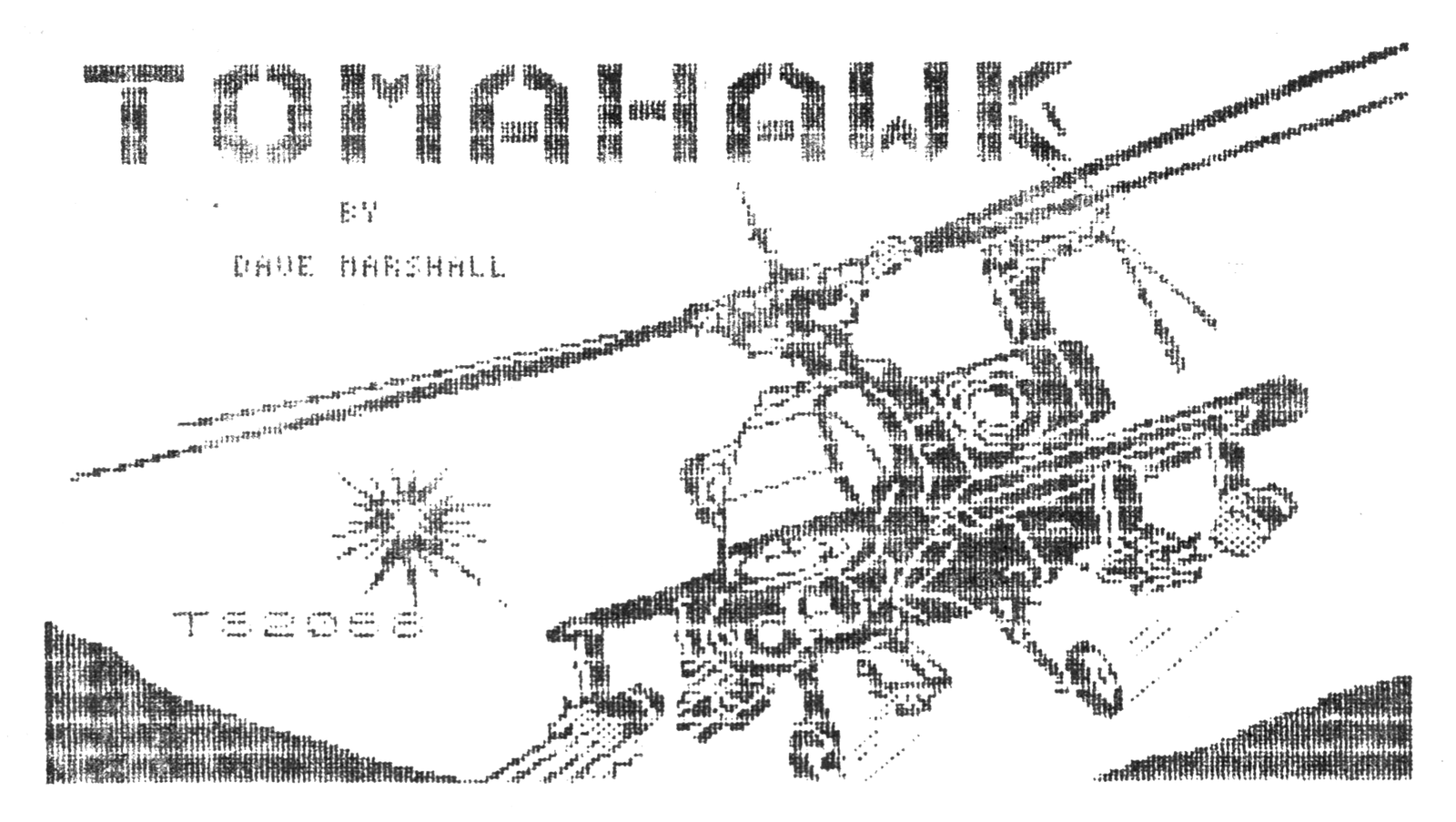
There are several flight simulation software for the T/S 2068. They include the original ‘Flight Simulator’. ‘Fighter Pilot’ – the F-15 simulation, ‘Night Gunner’ – the World War II bomber, and the great arcade type game ‘Penetrator.’ One that I have recently purchased is ‘Tomahawk.’ It simulates the U.S. Army attack helicopter – the AH-64A APACHE.
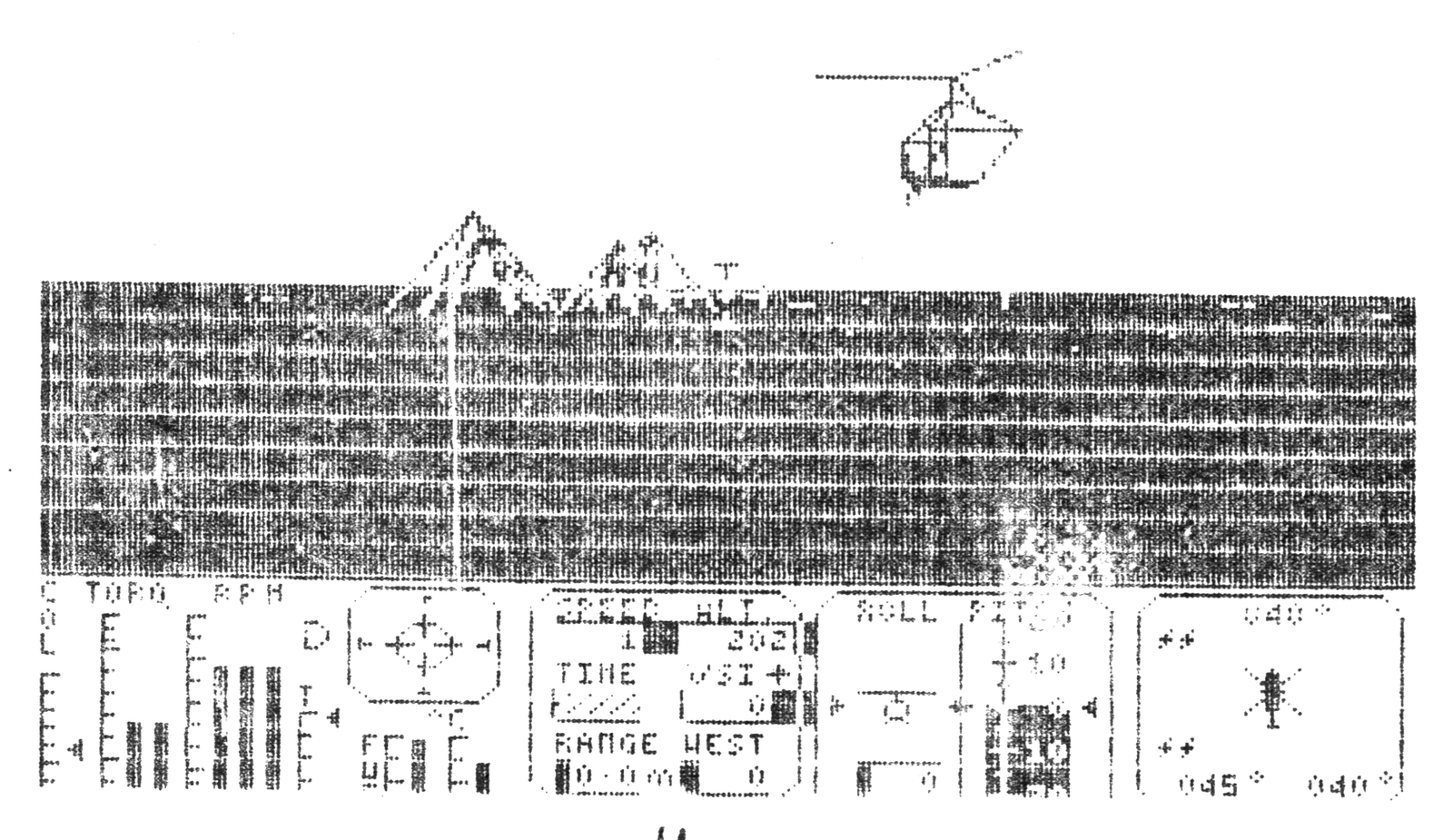
‘Tomahawk’ places you in the cockpit of this advanced aircraft. The lower third of the screen is the control panel that is very lifelike with colorful instrumentation that is responsive to the ‘pilot’s’ needs. Not only are there visual cues (7 colors are displayed) to control movements, but audio ones as well. If you over torque the engine or the Doppler navigation system spots an enemy helicopter, the pilot is warned. The rotor blades whir faster as the throttle is opened. The Doppler navigation system has four modes of operation that allow one to find enemy ‘copters, hunt out ground targets like tanks and field guns, choose other landing pads for refueling, rearming, and repair, and fly on beacon mode. The TADS (Target Acquisition & Designation System) seeks out helicopters, tanks, and field guns, displays them on its instrumentation, and visually pictures them in red or green to signify foe or friend. There are three levels of armament – guns that function up to a 2000 ft. range, rockets that are effective up to 4000 ft., and missiles with a lock-on feature that operate up to 3.1 miles. Various types of crosshairs designate each type and ‘lock-on.’ Would you believe that the instrument panel still has room for the artificial horizon that shows pitch, roll, drift, and pictures a tiny helicopter as you control it? This is in addition to visualization of the ammo supply, the four systems go no-go indicators, throttle and engine temperature dials, as well as a pilot’s visual display unit with speed, altitude, vertical speed indicator with up and down arrow, and time and distance to objective! And, believe it or not, it is very readable on my RGB monitor.
The upper two-thirds of the screen is the pilot’s view that is done three dimensionally with stick figures designating the more than 7000 purported ground objects. Once in the trainee mode (four modes from trainee to ace are available) where the enemy will not shoot back at you, one can skim along the ground at 100 feet and see the many objects that include clusters of trees, buildings, mountains, tanks, field guns, and landing pads. With practice one can fly between trees and around mountains. Should one meet with difficulty and crash land, a status report is given explaining the circumstances of your bad fortune.
‘Tomahawk’ has a map feature similar to ‘Flight Simulator.’ Relative positions of friendly and enemy helicopters are shown and red and blue colors characterize allied and enemy sectors. With so many controls this software requires the use of two joysticks (after all there is a pilot and co-pilot/gunner in the real situation) or the keyboard. I use the keyboard most of the time and it does keep me busy! The documentation is succinct, but adequate. You’ve got to use ‘Tomahawk’ and practice to become an ‘ace’ pilot. I was very impressed with the educational nature of this program. I learned an awful lot about the intricacies of piloting a helicopter and the frustrations faced ‘in the heat of the battle.’ One realizes that you can not only fly forward and backward but sideways as well. I often wonder if these simulations are easier or more difficult than the actual thing. A friend of mine who is a pilot and built his own plane has the ‘Flight Simulator’ software. While he can easily land his plane, he can never land the computer!
‘Tomahawk’ was purchased from T & C Services, 20 Liberty Terrace, Buffalo, N.Y., 14215. The tape program loaded easily and I had no problem making a ‘state’ save to my Oliger disk system. This program I would rate as superior and at a very affordable price of $12.00 with more savings if you use a money order or certified check. Service has been very good with my order arriving in about a week.