
Why should you consider the purchase of a SINCLAIR QL? Why, possessed of an excellent and only recently fulfilled system such as the Timex/Sinclair 2068, should you go to all the trouble and expense of switching systems–just think of the problem in transcribing your current files to Microdrive format? And why purchase a system that Sinclair Research doesn’t seem proud enough of to advertise, and which some have said is Uncle Clive’s first computer failure? Why opt for the QL instead of your current system, another reasonably priced wunderkind computer such as the new Atari, Commodore, or Amstrad, or, perhaps, a somewhat more expensive IBM PC-compatible? Finally, why consider a system which reviewers have generally panned? There are many excellent and indisputable reasons why you should consider such a purchase. Here are a few. There are many others.
A Best Buy!
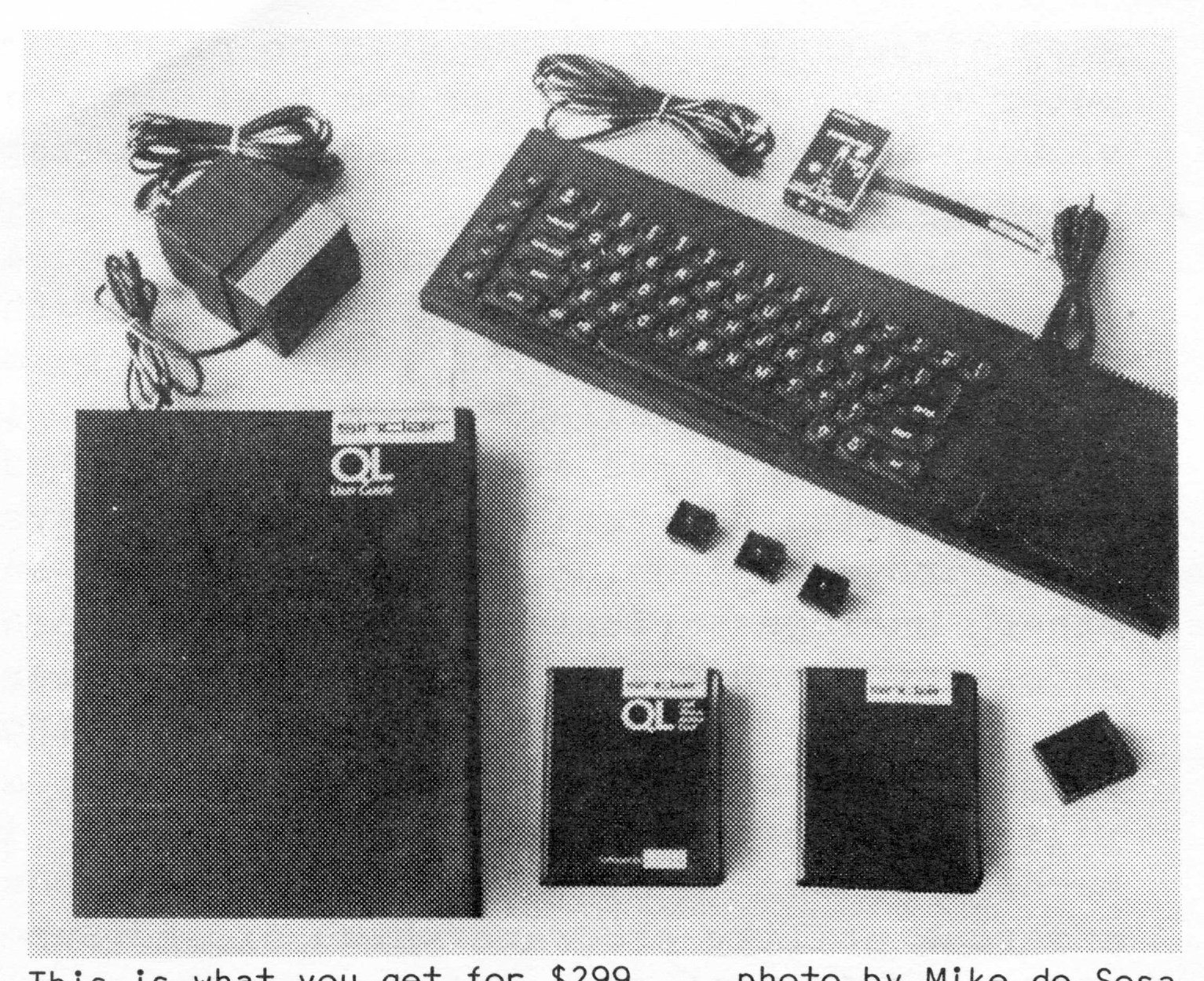
At the moment–and things do change–the Sinclair QL, with its compact and efficient keyboard console, its 32-bit CPU, its twin Microdrives, its excellent operating system and highly regarded SuperBASIC, its exceptional “bundled” software, its comprehensive user guide, and finally, its available hardware and software support, is a “best buy” by a considerable margin at $299. The U.S. version of the QL, its firmware, and its four semi-integrated software programs–now in their fourth or fifth version, comprise a mature and thoroughly debugged system for which dozens (who really needs thousands?) of excellent software programs and numerous state-of-the-art expansion and mass-storage systems are now available.
The QL Keyboard Console
The 3-pound keyboard console–a triumph of design and engineering, recognized as such by the Museum of Modern Art–includes all QL components except a separate one-pound power supply. QL components include two CPU’s, the 32-bit Motorola 68008 (cousin to that in the Apple Macintosh) and the 8-bit Intel 8049; four additional Sinclair-designed ICs; a full-sized, 65-key QWERTY keyboard, first-class in most respects but with no numeric keypad; twin, built-in Micro drives; expansion ports for extra RAM, disk drives, Microdrives, and peripherals; a ROM-cartridge port; two complementary joystick ports; two RS-232C serial interface ports, one optimized for output, one for input; an RGB monitor output providing 512 by 256-pixel definition in four colors; a TV output providing 256 by 256-pixel definition in eight colors; and two local-area-network ports by which up to 64 QLs may be connected in series to function interactively. All in all, the QL is remarkably compact, light, versatile, and powerful–it is the first lightweight, low-cost super-microcomputer, about which more later.
The QL ROM
The QL’s 48K ROM, expandable to 64K with a ROM Cartridge, consists of the QDOS (the QL operating system) and SuperBASIC, a major advance in computer languages. The QDOS is classified as “single-user, multi-tasking, time-sliced system” with “device-independent input and output.” What is all of this gobbledygook in simpler terms? The QDOS, by assigning time to two or more programs in separate, minute increments of ms. (microseconds), can run several programs simultaneously (or what seems like simultaneously). The source of program input or destination of program output may be specified when the program is run, obviating the need for duplication of effort in, for example, writing a program to send data alternatively to a monitor, printer, modem, or another networked QL. The QDOS also provides for multiple, and independently functioning “windows” on your monitor screen, with each displaying the data for a particular program.
The QL RAM
The QL offers a respectable, if not overly generous 128K of RAM, expandable in 64K, 128K, 256K, or 512K increments to a maximum 640K. (The QL video circuits require 32K of RAM, leaving 96K of RAM available for program and data; QL software programs may occupy upwards of 80K.) Two British firms are now replacing the two 64K RAM chips of the QL with two 256K chips, creating a Super QL with 512K RAM internally (the cost, $225 to $275). More than one million separate addresses (line numbers) are available in any QL RAM option.
QL SuperBASIC
A major inovation which some have suggested is the profound contribution of the QL system is Sinclair’s high-level, artificial language, SuperBASIC. More than an expanded Timex/Sinclair 2068 BASIC, SuperBASIC offers much greater flexibility than previous versions. User-defined procedures and functions–callable by name without reference to line numbers–may be used to extend an already much-enlarged SuperBASIC vocabulary. Data is more readily transferred between variable types, with string variables accepting numeric data and vice versa. Repetition, branching, decision-making, and other logical and array-handling procedures are improved. And the very mechanics of programming itself are automated. (Some, like the writer, will miss the “smart cursor” and single-keystroke aspects of previous Sinclair BASICs, but this sacrifice is acceptable considering the improvements.)
The QL Microdrives
Two built-in Microdrives are at one time the Achilles’ Heel of the QL and the key to its success. Much criticized at first but now relatively trouble-free, the tape drives operate superbly together to provide all the file flexibility and bulk storage you may ever need. Later versions provide, on average, about 115K of data storage (that is about 20,000 words) per Microdrive cartridge. Up to six external Microdrives may be connected, but the trend seems to be toward adding disk drives which operate in conjunction with the Microdrives. The four QL “bundled” software programs each load in less than twenty seconds.
After much deliberation, I have decided to forego disk-drives and expand my QL’s RAM, externally, to 512K. (External RAM cards are transferrable to other QLs and now operate a little faster than built-in RAM modifications.) I may get one “external” Microdrive to better facilitate file backup and database operations. External QL Microdrives are not yet available.
QL “Bundled” Software
The four software programs that come packaged with the QL at no extra cost are all first-class–two of them are genuinely superb (QL Archive, a database program, and QL Easel, a business graphics program). QL Quill, a “what you see is what you get” word processor, is very easy to use with only minor flaws that will, no doubt, be corrected in later versions. QL Abacus is a spreadsheet program, limited only by the maximum size of its grid and the absence of built-in statistical functions.
QL Archive is a “smart” filing system, programmable in its own command language, that is open-ended in it’s capabilities, limited in scope only by RAM available. More books and articles have been written regarding the applications and use of Archive than about any other QL software program, and this will continue to be the case. Not as easy to use as the other QL software programs, Archive is capable of automatically extracting desired data from several different files, manipulating and ordering it in complicated ways, and producing finished screen or hard-copy reports in any format desired.
QL Easel is the reviewers’ favorite QL software program. It has been suggested that every organization with a need to produce 35mm color graphics should own a QL, if only for that purpose. Simple to use, QL Easel produces graphics suitable for business, governmental, academic, or private use in eight basic formats, each one of which can be tailored to your preference in almost every way. Backgrounds, bars and lines of every sort, pie-chart segments, and annotations may be selected from many choices offered, or designed from scratch.
The programs are semi-integrated in their present version. To be fully integrated, all programs would have to be loaded in RAM at one time–occupying about 300K of RAM without their data files. But this too may change in later versions designed for use with QLs with much larger RAMs. All QL software programs–are comprehensively self-documented in on-line HELP facilities which take you directly to the information needed and return you precisely to the same spot in the program from which you called for help.
The QL is User-Friendly
The QL’s 32-bit CPU is designed to run several complex programs rapidly, but a spinoff of this chip architecture, perhaps more important in the long run, is that programs can be designed to be very simple in operation. And that is what has been done in the case of the QL and its bundled software. The QL and its software are designed to be used effectively by those with no prior computer experience and those who have not previously met with success using a computer.
Other QL Software
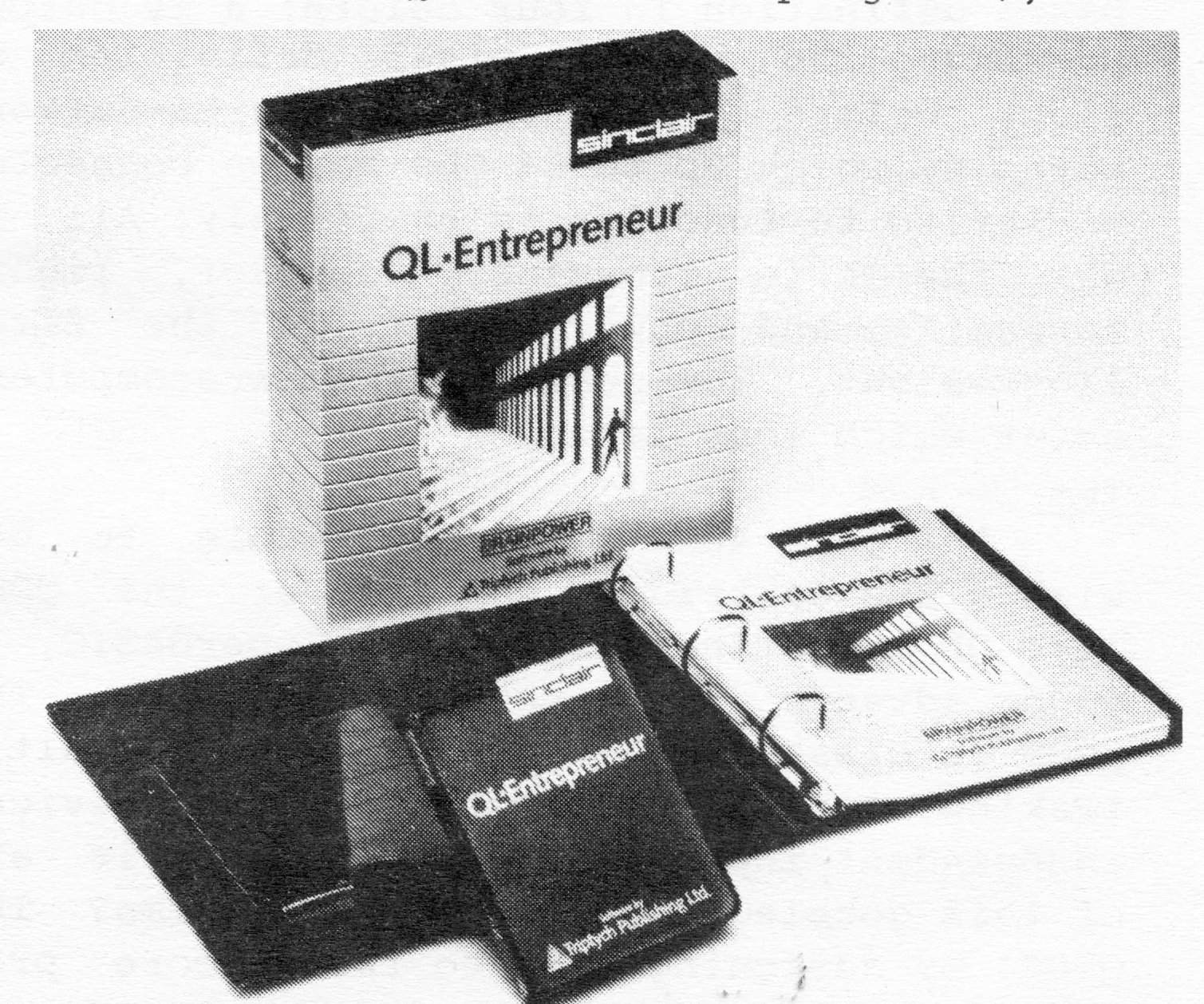
More than a hundred serious and recreational programs are now available in the U.K., with emphasis on the former. Most of these should be available from suppliers in the U.S. soon. Those available now include the following: several full-accounting systems; project-planning, decision-making, and other business-oriented programs; several excellent graphic arts programs; compilers for more than a dozen other programming-languages, including a revolutionary compiler for converting a SuperBASIC program to machine code; many educational programs; numerous utility programs which expand Super BASIC and facilitate routine operations, one in a manner that apes the Apple Macintosh; all sorts of games including excellent road-racing, bridge, and backgammon simulations, and two you-must-see-to-believe tennis and chess simulations from Psion Limited (producers of the QL software programs), the latter the ’84 Microcomputer Chess Champion; and other programs of every sort.
Third-party Hardware for the QL
Numerous state-of-the-art disk and expansion systems have been designed for the QL, including CP/M systems if that is your bag. The best of these will be marketed here –all at prices generally much less than those for other comparable systems.
The Future of the QL
Although the folks at Sinclair Research USA won’t tell, I believe that the QL in its present form will be a relatively long-lived computer perennial. There is some talk of a QL modification with expanded RAM, and a built in 3 1/2-inch disk drive, perhaps with the four QL software programs integrated as part of ROM. But this may not happen, or happen soon. Besides, if you purchase a QL now only to be confronted with a superior version later, you can always network your old QL with your new one.
European users of the QL had to wait many months for the bugs to be exterminated from the QL ROM, the Microdrives, and the QL software programs, and for compatible peripherals and software to appear. And the price of the QL was higher then. We now have a mature system with lots of backup offered to us at a bargain price.
I don’t know whether the Sinclair QL will be a market success in this country. I only know that the QL as the first lightweight, low-cost supermicrocomputer–a technological and historic watershed that may foreshadow revolutionary changes in most aspects of the computer world–deserves to be a success. Any questions?
Next time–programming in SuperBASIC on the Sinclair QL.
MIKE DE SOSA is a retired Air Force officer, with a Ph.D. from the University of Oregon, who has completed a comprehensive book on the QL and its software, and is now looking for a publisher.