
Speech synthesizers are like a lot of inexpensive computer add-ons…they aren’t really essential compared to say a printer. However, they can be a lot of fun, and with a little bit of imagingation, could be put to some sort of use.
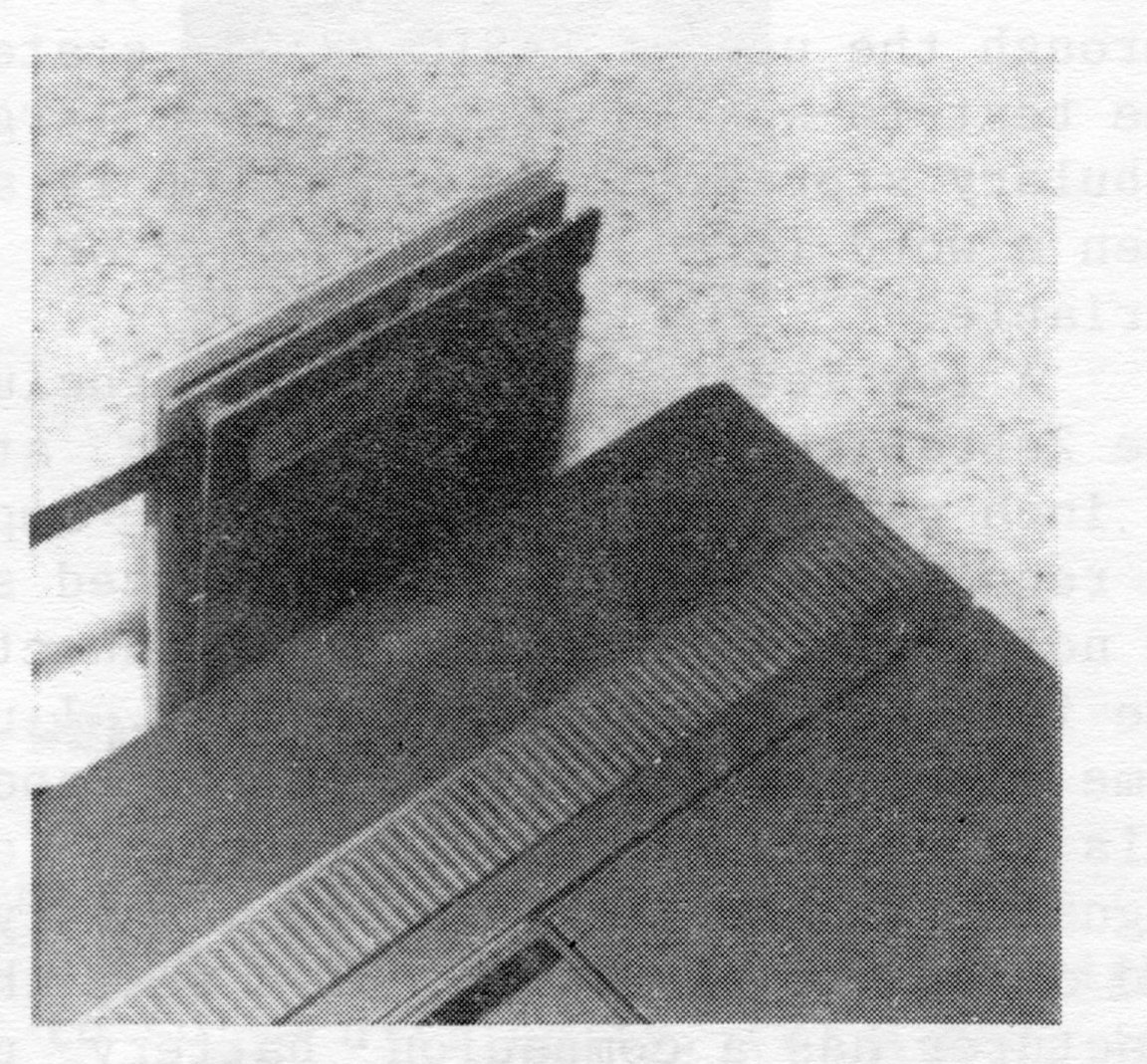
The ZEBRA-TALKER is a thin module that plugs into the back of the Timex/Sinclair 2068, with a straight-thru connector provided for attachment of other peripherals. The pc board is covered and protected on both sides by thick cardboard. The Zebra-Talker doesn’t draw any power from the 2068 because of a small 7.5 DCV transformer that is provided (just what every Timex owner needs–one more transformer). The heart of the unit is the Votrax SC-01 Speech Chip.
This particular type of speech device uses 45 basic speech “sounds” which are called phonemes. The phonemes can be linked together to produce around 1,400 words. More words can be produced by combining various sounds to simulate words. Phonemes are entered by typing in codes. A very nice 20 page dictionary of words and there related codes is provided.
To assist the Zebra-Talker user, is a phoneme editor on cassette software. It is menu-driven, and simplifys entering the codes. If you have made a mistake, or wish to add or change your words, special commands can be used to speed up the chore. I found that the editor was simple, but somewhat slow in it’s execution. Also on the same tape is a “text-to-speech” MC program that allows the Zebra-Talker to operate through the use of BASIC PRINT statements. The text-to-speech routine has a large vocabulary stored in memory, which is scanned when a word is put into a string or string variable.
A low level output line is included on the Zebra-Taker via a permanently attached 12 inch patch cord. An external amplifier is required to hear the synthesized speech, as no provision is made for a connection to the internal speaker on the 2068. I used a home stereo amplifier and pair of speakers. This gave very excellent results, as the signal from the Zebra-Talker was very clean and crisp. It should be noted that the manufacturer has a companion battery powered amp/speaker combination for $12.50. It was untested by me, but experience tells me that it must be a low-volume device. I feel that the stereo, or a similar means is very suitable for the home user.
When I first hooked it up, and typed in the simple codes for the words “hello”, the voice coming from the loudspeakers was both chilling and funny at the same time. With further use and experimentation, the newness quickly wore off. If you have heard one of those T/I “Speak And Spells” that have been around for educational purposes, you might somehow imagine what the Zebra-Talker sounds like. One feature, that takes away the semi-monotone effect is selectable speech inflection (or level of pitch). Four levels are accessible.
Good documentation is provided. If you think this device is for you, by all means buy one. There are routines shown to include speech in your own programs, so someone out there probably has come up with a good use for the Zebra-Talker. It can be purchased from Zebra Systems, 78-06 Jamaica Ave., Woodhaven, NY 11421, for $69.95 plus $3.00 s & h. There is also a version for the T/S 1000 for $64.95.