
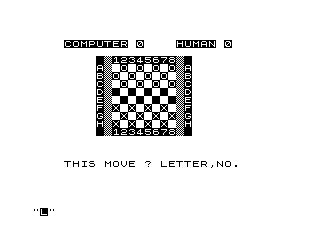
Draughts is a two-player checkers game for a single human opponent against the computer, requiring 16K of RAM. The board is represented as a one-dimensional array A(100) with only certain indices used to model the diagonal playable squares, and piece types are stored as character codes (e.g., H=189, C=180, W=188, K=176, B=128) so they can be printed directly with CHR$. User input uses a letter-number coordinate system (e.g., “A2”), which is decoded by computing CODE B$(1)*10+CODE B$(2) and mapping through a long chain of IF statements to internal array indices. The computer’s move logic includes a capture-priority routine, a positional look-ahead that checks for unsafe moves, and a fallback random-move generator using a shuffled index array I(49). Kings are promoted automatically when a computer piece reaches row A, and the game tracks captured pieces for both sides with score counters S and T.
Program Analysis
Program Structure
The program is organized into clearly delineated sections, each beginning at a round line number:
- Lines 5–70: Initialization and first-move selection.
- Lines 1000–1460: Human move input and coordinate decoding.
- Lines 2000–2490: Computer move logic — capture, intelligent move, and random move phases.
- Lines 7000–7320: Board display subroutine.
- Lines 8000–8050: Capture-check subroutine.
- Lines 9000–9420: Initialization, board setup, and SAVE block.
Board Representation
The board is stored in a one-dimensional array A(100). Only a subset of indices — those mapping to playable dark squares — are used; out-of-bounds and non-playable cells are filled with 9 as a sentinel value. The diagonal neighbor offsets are held in X(4) with values -6, -7, 6, and 7, reflecting the staggered layout of usable indices across alternating rows of four.
Piece types are stored as character code integers so they can be printed directly via CHR$:
| Variable | Value | Meaning |
|---|---|---|
H | 189 | Human man |
W | 188 | Human king |
C | 180 | Computer man |
K | 176 | Computer king |
B | 128 | Empty square |
9 | 9 | Off-board sentinel |
Coordinate Decoding
Human input is a two-character string such as "A2". The program computes CODE B$(1)*10+CODE C$(2) to produce a two-or-three digit numeric key (e.g., 410 for A1), then maps each key to an internal array index through a chain of 32 IF statements (lines 1090–1400). This approach avoids any arithmetic formula for the irregular index layout and handles the two-dimensional coordinate system entirely through lookup.
Computer Move Logic
The computer’s turn is handled in three prioritized phases:
- Forced captures (lines 2000–2210): Iterates over all computer pieces; calls subroutine 8000 to check whether a jump is available from square
Z. If so, executes the capture, updates scores inS, clears the jumped piece, redraws the board, and loops to check for chain captures. - Intelligent move (lines 2240–2345): Scans all computer pieces and for each diagonal direction checks whether moving there would expose the piece to immediate recapture, or whether it can move a piece that is already under threat. The condition on line 2280–2290 implements rudimentary positional avoidance.
- Random move (lines 2348–2490): Builds an array
I(49)of all valid board indices, then repeatedly draws random entries (removing each after selection via a swap-and-shrink technique) until a legal move is found. A flagITtracks whether the “safe-move” filter is active; on the second pass (IT=1) the safety check is skipped. If no move is found at all,E$="LOSE"is set and the game ends with a concession message.
Subroutines
Subroutine at line 8000 checks all four diagonal directions from square Z for a valid capture: an enemy piece adjacent and an empty square beyond. It respects piece type — men only move in directions D=1,2 (indices 1–2 in X), while kings use all four. The result is returned in Q (the offset of the jump direction, or 0 if none).
Subroutine at line 7000 redraws the full board display using PRINT AT with CHR$ of each array cell value, displays captured-piece tallies using CHR$ (S+156) and CHR$ (T+156) (block graphics characters whose density represents count), checks win/lose/concede conditions, and optionally prompts for a chain-jump continuation.
King Promotion
Computer men reaching the human’s back row (squares 69–72) are promoted to kings at line 2005: IF A(Z)=H THEN LET A(Z)=W — note this promotes human pieces that reach the computer’s back row (rows A, i.e., indices 69–72). Computer man promotion to king (C → K) is handled at line 2030 when a computer piece occupies indices 24–27 (the human’s home row).
Notable Techniques
- The random-move picker uses a partial Fisher-Yates style draw:
I(Y)=I(N)followed byN=N-1ensures each board square is tried at most once without a full shuffle. FAST/SLOWmode switching is used strategically — display updates run in SLOW for visible rendering; computation runs in FAST.- The move-legality check for the human relies entirely on the player entering correct notation; there is no validation of whether the input square actually contains a human piece or whether the destination is legal, meaning illegal moves are silently accepted.
- The midpoint formula
(B(1)+B(2))/2at line 1460 to find the captured piece’s square is only valid when the jump distance is exactly one step (offset 6 or 7). Multi-step captures by the human are not detected automatically — the game prompts “CAN YOU JUMP AGAIN?” and relies on the human to input the continuation. - Line 1200 appears to be a bug: both
Z(U)=432andZ(U)=436map toB(U)=56, which means coordinate B4 and B6 map to the same internal square. The correct value for B4 should likely be58(one of the row-B indices), suggesting a transcription error in the coordinate table.
Initialization
Lines 9000–9390 allocate all arrays, set piece-code constants, place pieces on the board by filtering index ranges with multiple AND conditions to skip non-playable cells, and offer the human the choice of moving first. If the computer moves first, it makes a simple random opening move by picking from indices near the center of its starting rows.
Image Gallery
Source Code
   5 REM DRAUGHTS-16K
  10 FAST
  20 RAND
  30 GOSUB 9000
  50 LET MOVE=0
  60 GOSUB 7000
  70 SLOW
 1000 IF C$(1)="K" THEN GOTO 1010
 1005 PRINT AT 16,3;"YOUR LAST MOVE WAS TO ";C$
 1010 LET MOVE=0
 1015 PRINT AT 17,4;"THIS MOVE ? LETTER,NO.  "
 1020 INPUT B$
 1030 PRINT AT 17,14;" FROM ";B$;" TO ? "
 1040 INPUT C$
 1050 PRINT AT 17,25;" ";C$,"[S][T][A][N][D]█[B][Y]"
 1060 LET Z(1)=CODE B$(1)*10+CODE B$(2)
 1070 LET Z(2)=CODE C$(1)*10+CODE C$(2)
 1080 FOR U=1 TO 2
 1090 IF Z(U)=410 THEN LET B(U)=72
 1100 IF Z(U)=412 THEN LET B(U)=71
 1110 IF Z(U)=414 THEN LET B(U)=70
 1120 IF Z(U)=416 THEN LET B(U)=69
 1130 IF Z(U)=419 THEN LET B(U)=66
 1140 IF Z(U)=421 THEN LET B(U)=65
 1150 IF Z(U)=423 THEN LET B(U)=64
 1160 IF Z(U)=425 THEN LET B(U)=63
 1170 IF Z(U)=430 THEN LET B(U)=59
 1180 IF Z(U)=432 THEN LET B(U)=56
 1190 IF Z(U)=434 THEN LET B(U)=57
 1200 IF Z(U)=436 THEN LET B(U)=56
 1210 IF Z(U)=439 THEN LET B(U)=53
 1220 IF Z(U)=441 THEN LET B(U)=52
 1230 IF Z(U)=443 THEN LET B(U)=51
 1240 IF Z(U)=445 THEN LET B(U)=50
 1250 IF Z(U)=450 THEN LET B(U)=46
 1260 IF Z(U)=452 THEN LET B(U)=45
 1270 IF Z(U)=454 THEN LET B(U)=44
 1280 IF Z(U)=456 THEN LET B(U)=43
 1290 IF Z(U)=459 THEN LET B(U)=40
 1300 IF Z(U)=461 THEN LET B(U)=39
 1310 IF Z(U)=463 THEN LET B(U)=38
 1320 IF Z(U)=465 THEN LET B(U)=37
 1330 IF Z(U)=470 THEN LET B(U)=33
 1340 IF Z(U)=472 THEN LET B(U)=32
 1350 IF Z(U)=474 THEN LET B(U)=31
 1360 IF Z(U)=476 THEN LET B(U)=30
 1370 IF Z(U)=479 THEN LET B(U)=27
 1380 IF Z(U)=481 THEN LET B(U)=26
 1390 IF Z(U)=483 THEN LET B(U)=25
 1400 IF Z(U)=485 THEN LET B(U)=24
 1410 NEXT U
 1420 LET MOVE=0
 1430 LET A(B(2))=A(B(1))
 1440 LET A(B(1))=B
 1450 IF ABS (B(1)-B(2))>7 THEN LET MOVE=1
 1460 IF ABS (B(1)-B(2))>7 THEN LET A((B(1)+B(2))/2)=B
 1465 FAST
 1470 GOSUB 7000
 2000 REM [C][A][P][T][U][R][E]
 2002 LET Q=0
 2004 FOR Z=69 TO 72
 2005 IF A(Z)=H THEN LET A(Z)=W
 2007 NEXT Z
 2009 FOR Z=24 TO 72
 2020 IF A(Z)<>C AND A(Z)<>K THEN GOTO 2110
 2030 IF A(Z)=C AND Z>23 AND Z<28 THEN LET A(Z)=K
 2040 GOSUB 8000
 2080 IF Q<>0 THEN GOTO 2125
 2110 NEXT Z
 2120 GOTO 2240
 2125 LET A(Z+2*Q)=A(Z)
 2130 LET S=S+1
 2135 LET A(Z+Q)=B
 2145 LET A(Z)=B
 2150 GOSUB 7000
 2155 LET Z=Z+2*Q
 2160 LET Q=0
 2170 GOSUB 8000
 2190 IF Q<>0 THEN GOTO 2125
 2210 GOTO 50
 2235 REM [I][N][T][E][L][L][I][G][E][N][T]█[M][O][V][E]
 2240 FOR Z=24 TO 72
 2250 IF A(Z)=9 OR A(Z)=B OR A(Z)=H OR A(Z)=W THEN GOTO 2305
 2260 FOR D=1 TO 4
 2270 IF A(Z+X(D))=H AND D<3 THEN GOTO 2290
 2280 IF (A(Z+X(D))=H OR A(Z+X(D))=W) AND A(Z-X(D))=B AND A(Z-2*X(D))=K THEN LET Q=Z-2*X(D)
 2290 IF Q=0 AND (A(Z+X(D))=H OR A(Z+X(D))=W) AND A(Z-X(D))=B AND (A(Z-2*X(D))=K OR A(Z-2*X(D))=C) THEN LET Q=Z-2*X(D)
 2300 IF Q=0 THEN NEXT D
 2305 IF Q=0 THEN NEXT Z
 2310 IF Q=0 THEN GOTO 2348
 2320 LET A(Q+X(D))=A(Q)
 2330 LET A(Q)=B
 2340 GOSUB 7000
 2345 GOTO 50
 2347 REM [R][A][N][D][O][M]█[M][O][V][E]
 2348 FAST
 2349 LET IT=0
 2350 DIM I(49)
 2355 FOR J=1 TO 49
 2360 LET I(J)=J+23
 2365 NEXT J
 2370 LET N=49
 2373 LET Y=1+INT (RND*N)
 2375 LET Z=I(Y)
 2380 IF A(Z)=9 OR A(Z)=B OR A(Z)=H OR A(Z)=W THEN GOTO 2430
 2390 FOR D=1 TO 4
 2400 IF A(Z)=C AND D>2 THEN GOTO 2430
 2404 IF IT=1 THEN GOTO 2410
 2406 IF A(Z+X(D))=B AND A(Z+2*X(D))<>H AND A(Z+2*X(D))<>W AND A(Z+13*SGN X(D))<>H AND A(Z+13*SGN X(D))<>W AND A(Z-1+2*(ABS (D-25)>1))<>H AND A(Z-1+2*(ABS (D-25)>1))<>W THEN LET Q=X(D)
 2408 GOTO 2420
 2410 IF A(Z+X(D))=B THEN LET Q=X(D)
 2420 IF Q<>0 THEN GOTO 2460
 2425 NEXT D
 2430 LET I(Y)=I(N)
 2433 LET N=N-1
 2436 IF N>0 THEN GOTO 2373
 2438 LET IT=IT+1
 2439 IF IT=1 THEN GOTO 2355
 2440 LET E$="LOSE"
 2450 GOTO 7000
 2460 LET A(Z+Q)=A(Z)
 2470 LET A(Z)=B
 2490 GOTO 50
 7000 REM [P][R][I][N][T]█[B][O][A][R][D]
 7005 SLOW
 7007 PAUSE 250
 7010 PRINT AT 16,0;"                                "
 7020 PRINT AT 17,0;"                                            "
 7030 IF MOVE=1 THEN LET T=T+1
 7090 PRINT AT 2,4;"[C][O][M][P][U][T][E][R] ";CHR$ (S+156),"  [H][U][M][A][N] ";CHR$ (T+156)
 7100 PRINT AT 4,8;"█▒[1][2][3][4][5][6][7][8]▒█"
 7110 PRINT AT 5,8;"[A]▒ ";CHR$ A(72);" ";CHR$ A(71);" ";CHR$ A(70);" ";CHR$ A(69);"▒[A]"
 7120 PRINT AT 6,8;"[B]▒";CHR$ A(66);" ";CHR$ A(65);" ";CHR$ A(64);" ";CHR$ A(63);" ▒[B]"
 7130 PRINT AT 7,8;"[C]▒ ";CHR$ A(59);" ";CHR$ A(58);" ";CHR$ A(57);" ";CHR$ A(56);"▒[C]"
 7140 PRINT AT 8,8;"[D]▒";CHR$ A(53);" ";CHR$ A(52);" ";CHR$ A(51);" ";CHR$ A(50);" ▒[D]"
 7150 PRINT AT 9,8;"[E]▒ ";CHR$ A(46);" ";CHR$ A(45);" ";CHR$ A(44);" ";CHR$ A(43);"▒[E]"
 7160 PRINT AT 10,8;"[F]▒";CHR$ A(40);" ";CHR$ A(39);" ";CHR$ A(38);" ";CHR$ A(37);" ▒[F]"
 7170 PRINT AT 11,8;"[G]▒ ";CHR$ A(33);" ";CHR$ A(32);" ";CHR$ A(31);" ";CHR$ A(30);"▒[G]"
 7180 PRINT AT 12,8;"[H]▒";CHR$ A(27);" ";CHR$ A(26);" ";CHR$ A(25);" ";CHR$ A(24);" ▒[H]"
 7190 PRINT AT 13,8;"█▒[1][2][3][4][5][6][7][8]▒█"
 7195 FAST
 7210 IF E$="LOSE" THEN PRINT AT 17,7;"[I]█[C][O][N][C][E][D][E]█[T][H][E]█[G][A][M][E]"
 7220 IF E$="LOSE" THEN STOP
 7230 IF S>=12 THEN PRINT AT 17,12;"[I]█[W][I][N]"
 7240 IF T>=12 THEN PRINT AT 17,10;"[Y][O][U]█[W][I][N]"
 7250 IF S>=12 OR T>=12 THEN STOP
 7260 LET U$=""
 7270 IF MOVE=1 THEN PRINT AT 15,2;"CAN YOU JUMP AGAIN?(Y OR N)"
 7280 IF MOVE=1 THEN INPUT U$
 7290 PRINT AT 15,2;"                              "
 7300 LET MOVE=0
 7310 IF U$="Y" THEN GOTO 1000
 7320 RETURN
 8000 FOR D=1 TO 4
 8010 IF A(Z)<>K AND D>2 THEN GOTO 8050
 8020 IF (A(Z+X(D))=H OR A(Z+X(D))=W) AND A(Z+2*X(D))=B THEN LET Q=X(D)
 8030 IF Q<>0 THEN GOTO 8050
 8040 NEXT D
 8050 RETURN
 9000 DIM A(100)
 9005 LET Y=0
 9010 DIM X(4)
 9020 LET X(1)=-6
 9030 LET X(2)=-7
 9040 LET X(3)=6
 9050 LET X(4)=7
 9060 LET H=189
 9070 LET C=180
 9080 LET W=188
 9090 LET K=176
 9100 LET B=128
 9105 LET Q=0
 9110 FOR Z=1 TO 100
 9120 LET A(Z)=9
 9130 IF Z<73 AND Z>55 AND Z<>67 AND Z<>68 AND Z<>60 AND Z<>61 AND Z<>62 THEN LET A(Z)=C
 9140 IF Z<54 AND Z>42 AND Z<>47 AND Z<>48 AND Z<>49 THEN LET A(Z)=B
 9150 IF Z<41 AND Z>23 AND Z<>34 AND Z<>35 AND Z<>36 AND Z<>28 AND Z<>29 THEN LET A(Z)=H
 9160 NEXT Z
 9170 LET E$=""
 9180 LET S=0
 9190 LET T=0
 9210 DIM B$(2)
 9220 DIM C$(2)
 9225 LET C$(1)="K"
 9230 DIM Z(2)
 9240 DIM B(2)
 9300 PRINT AT 10,4;"[D][O]█[Y][O][U]█[W][A][N][T]█[T][H][E]█[F][I][R][S][T]█[M][O][V][E][?]";TAB 9;" [Y]█[O][R]█[N][?] "
 9310 INPUT Y$
 9320 CLS
 9330 IF Y$="Y" THEN RETURN
 9335 LET MOVE=0
 9340 GOSUB 7000
 9350 LET Z=57+INT (RND*3)
 9360 LET Q=-7+INT (RND*2)
 9370 LET A(Z+Q)=C
 9380 LET A(Z)=B
 9390 RETURN
 9400 CLEAR
 9410 SAVE "1029[4]"
 9420 RUN
Note: Type-in program listings on this website use ZMAKEBAS notation for graphics characters.