
This program calculates seven inductive formulas useful in electronics design, covering instantaneous voltage, single-layer coil inductance, L/R time constants, series and parallel inductors, coil Q factor, inductive reactance (XL), and the impedance of inductive/resistive circuits. Menu selection is stored in variable F but the branch logic erroneously tests variable U (which is never assigned), meaning formula dispatch never works as intended. A custom iterative square-root subroutine at line 3030 uses Newton’s method, converging by checking when successive corrections W equal zero or repeat, since the platform lacks a built-in SQR function. Unit conversions between millihenries and henries (dividing by 1E3) and microfarads and farads (dividing by 1E6) are handled inline throughout the calculation routines.
Program Structure
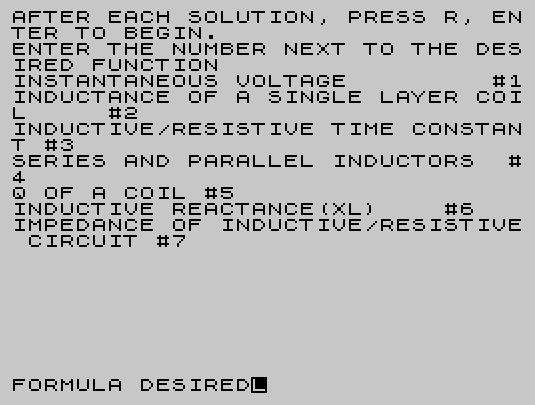
The program presents a numbered menu (lines 10–90) for seven inductive formulas, accepts a selection via INPUT at line 100, and then is supposed to branch to the appropriate calculation routine. The calculation blocks are spread across lines 120–590, followed by a standalone square-root subroutine at lines 3010–3090. Line 9992 provides a SAVE with auto-run, and line 9999 loops back to line 80 (the last menu item print) via GO TO VAL "80".
Critical Bug: Variable Mismatch in Dispatch
The user’s menu choice is read into variable F at line 100, but the branch conditions at lines 120–150 all test variable U, which is never assigned anywhere in the program. As a result, U will always be zero, none of the IF U=... branches will trigger, and execution falls through unconditionally to line 170 — the resonant frequency calculation block — regardless of which formula the user selects. All seven formula paths are effectively unreachable except that one. The correct variable in each condition should be F.
Incomplete Dispatch Table
Even if the variable were corrected, the dispatch logic is incomplete. The menu advertises seven formulas (#1 through #7), but the branch table only covers cases 3, 4, 5, and 6 (lines 120–150). There are no branches for selections 1, 2, or 7, and line 110 carries only a REM comment reading “LEFT OFF HERE,” suggesting the program was never finished. The blocks starting at lines 520–590 (labeled in the code for formula #7, impedance) are present but unreachable via any corrected dispatch.
Square-Root Subroutine
Because the platform lacks a native SQR function, a Newton’s-method iterative square-root routine occupies lines 3010–3090. It takes input in X and returns the result in Y, using W and Z as internal working variables.
- Line 3030 short-circuits for
X=0, returningY=0immediately. - Line 3040–3050 guards against negative inputs, printing an error and halting.
- Line 3060 seeds the initial estimate as
Y = X * 0.5. - Line 3070 computes the Newton correction:
W = (X/Y - Y) * 0.5. - Line 3080 terminates when
W=0(converged) orW=Z(oscillating between two values), then returns. - Line 3090 updates
Yand saves the previous correction inZbefore looping.
Note that line 3030 uses the literal character O (letter O) rather than the digit 0 for the zero comparisons and assignment. On this platform, an uninitialized string variable named O would cause an error, but if O is treated as a numeric variable it defaults to zero — so the routine works accidentally but is technically a coding error.
Unit Handling
All electrical unit conversions are performed inline. Inductance values entered in millihenries are converted to henries by dividing by 1E3, and capacitance values in microfarads are converted to farads by dividing by 1E6. Results are scaled back to display units before printing (e.g., L*1E3, C*1E6).
Notable Idioms and Observations
GO TO VAL "80"at line 9999 is a memory-saving idiom substituting a string literal for a numeric constant in the branch target.- The resonant frequency formula at line 230 uses the constant 159 (approximation of 1/(2π) × 1000, accounting for the mH/µF unit scaling) rather than computing
1/(2*PI*SQR(LC))explicitly, leveraging the custom subroutine outputY. - Lines 235, 275, 315, 350, 430, 470, 510, 590, 3000, and 9989 all use
STOPto terminate execution after each formula, preventing fall-through between blocks. - The Q-of-circuit section (lines 360–510) uses
INPUTwith a prompt asking the user to typeQ,F, orBas a letter, then compares the input to the BASIC variablesQ,F, andB— a creative but fragile technique that depends on those variables being zero (their default) so the comparison resolves correctly only when the user enters0.
Image Gallery
Source Code
    1 REM \{20}\{1}INDUCTIVE FORMULAS BY ROY BABYLON POPULAR ELECTRONICS AUG 1979 PAGE 47\{20}\{0}
    5 CLS
   10 PRINT "AFTER EACH SOLUTION, PRESS R, ENTER TO BEGIN."
   20 PRINT "ENTER THE NUMBER NEXT  TO THE DESIRED FUNCTION"
   30 PRINT "INSTANTANEOUS VOLTAGE         #1"
   40 PRINT "INDUCTANCE OF A SINGLE LAYER COIL     #2"
   50 PRINT "INDUCTIVE/RESISTIVE TIME CONSTANT #3"
   60 PRINT "SERIES AND PARALLEL INDUCTORS  #4"
   70 PRINT "Q OF A COIL #5"
   80 PRINT "INDUCTIVE REACTANCE(XL)    #6"
   90 PRINT "IMPEDANCE OF INDUCTIVE/RESISTIVE CIRCUIT #7"
  100 INPUT "FORMULA DESIRED";F
  110 REM ****LEFT OFF HERE
  120 IF U=3 THEN GO TO 280
  130 IF U=4 THEN GO TO 320
  140 IF U=5 THEN GO TO 360
  150 IF U=6 THEN GO TO 520
  170 INPUT "ENTER VALUE OF INDUCTOR IN MILLIHENRIES";L
  180 INPUT "ENTER VALUE OF CAPACITOR IN MICROFARADS";C
  210 LET X=(L/1E3)*(C/1E6)
  220 GO SUB 3030
  230 PRINT "THE RESONANT FREQUENCY IS";159/Y;"HERTZ"
  235 STOP
  240 INPUT "ENTER RESONANT FREQUENCY(FO)DESIRED";F
  250 INPUT "ENTER CAPACITOR VALUE IN MICROFARADS";C
  260 LET L=.0254/(F*F)*(C/1E6)
  270 PRINT "THE INDUCTOR NEEDED IS ";L*1E3;"MILLIHENRIES"
  275 STOP
  280 INPUT "ENTER RESONANT FREQUENCY(FO)DESIRED";F
  290 INPUT "ENTER INDUCTOR VALUE IN MILLIHENRIES";L
  300 LET C=.0254/(F*F)*(L/1E3)
  310 PRINT "THE CAPACITOR NEEDED IS ";C*1E6;"MICROFARADS"
  315 STOP
  320 PRINT "ENTER THE REACTANCE(XC OR XL)IN OHMS";X
  330 PRINT "ENTER THE SERIES RESISTANCE IN OHMS";R
  340 PRINT "THE Q OF THE CIRCUIT IS";X/R;"UNITS"
  350 STOP
  360 INPUT "ENTER UNKNOWN, Q=Q, FO=F,BW=B";X
  370 IF X=Q THEN GO TO 400
  380 IF X=F THEN GO TO 440
  390 IF X=B THEN GO TO 480
  400 INPUT "ENTER FO IN HERTZ";F
  410 INPUT "ENTER BW(F2-F1)IN HERTZ";B
  420 PRINT "THE Q IS EQUAL TO ";F/B;"UNITS"
  430 STOP
  440 INPUT "ENTER THE Q OF THE CIRCUIT";Q
  450 INPUT "ENTER BW(F2-F1)IN HERTZ";B
  460 PRINT "THE RESONANT FREQUENCY(FO)IS";Q*B;"HERTZ"
  470 STOP
  480 INPUT "ENTER RESONANT FREQUENCY(FO)IN HERTZ";F
  490 INPUT "ENTER THE Q VALUE";Q
  500 PRINT "THE BANDWIDTH IS";F/Q;"HERTZ"
  510 STOP
  520 INPUT "ENTER VALUE OF INDUCTOR IN MILLIHENRIES";L
  530 INPUT "ENTER FREQUENCY(FO)IN HERTZ";F
  540 INPUT "ENTER RESISTOR VALUE IN OHMS";R
  550 PRINT "AT SERIES RESONANCE,XL AND XC CANCEL THEREFORE Z=";R
  560 LET P=(2* PI)*(F)*(L/1E3)
  570 LET Q=P/R
  580 PRINT "THE PARALLEL IMPEDANCE IS EQUAL TO";P*Q;"OHMS"
  590 STOP
 3000 STOP
 3010 REM *SQUARE ROOT*INPUT X,OUTPUT Y
 3020 REM ALSO USES W&Z INTERNALLY
 3030 IF X=O THEN LET Y=O:RETURN
 3040 IF X>O THEN GO TO 3060
 3050 PRINT "ROOT OF NEGATIVE NUMBER?":STOP
 3060 LET Y=X*.5:LET Z=O
 3070 LET W=(X/Y-Y)*.5
 3080 IF (W=O)+(W=Z) THEN RETURN
 3090 LET Y=Y+W:LET Z=W:GO TO 3070
 9989 STOP
 9992 SAVE "INDUCT.B1" LINE SGN PI
 9998 REM
 9999 GO TO VAL "80"
Note: Type-in program listings on this website use ZMAKEBAS notation for graphics characters.