
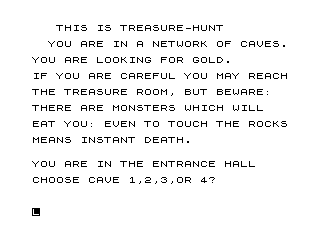
Treasure Hunt is a real-time dungeon exploration game in which the player navigates a network of interconnected caves searching for gold, avoiding rock walls and pursuing demons. The cave map is encoded compactly in string B$ at lines 70–76, where each room’s three exits are stored as ASCII characters offset by 37, allowing up to 21 rooms including a special Treasure Room (room 21). Movement uses the classic Sinclair 5/6/7/8 key layout, and the player can fire arrows in a chosen direction by pressing F followed by a direction key. The program uses PEEK of the display file base address (obtained at line 55 via PEEK 16396/16397) to detect collisions with cave walls and other obstacles without maintaining a separate map array. A score/economy system lets the player bank treasure between runs, buy extra arrows at 4 points each, and survive death with a 15-point penalty if their cumulative score is high enough.
Program Analysis
Program Structure
The program is divided into several functional regions:
- Lines 1–95: Initialisation — arrays, string constants, score variables, display-file address, map data, and random seed.
- Lines 150–360: Cave rendering and main game loop — draw walls, place demons, move hero, handle arrow firing, and detect collisions.
- Lines 605–970: Room-switch logic — tunnel display, exit lookup from
B$, and re-entry into the drawing routine. - Lines 1000–1125: Arrow-firing subroutine.
- Lines 1200–1255: Demon movement subroutine.
- Lines 1295–1660: Start sequence, entrance hall, treasure banking, and arrow purchasing.
- Lines 2000–2040: Death handler with conditional continue.
- Lines 2045–2115: Treasure Room setup (room 21).
- Lines 2999–3035: Trap/guardian movement subroutine used only in the Treasure Room.
Cave Map Encoding
The 21-room graph is stored in string B$ (lines 70–76) as a flat sequence of ASCII characters. Each room occupies three consecutive characters representing its three exits. Exit numbers are recovered by subtracting 37 from the character code, so the digit 9 (ASCII 57) maps to room 20, A (65) to room 28, etc. The decoding occurs at lines 920–945:
R1— left/top exit (displayed at top of screen)R2— right/bottom exit (displayed at bottom)R3— third exit used as a replacement when the player came fromR1orR2
Lines 960–965 swap out the “back” exit so the on-screen numbers always show two new destinations, preventing the player from trivially retracing steps.
Display-File Collision Detection
Line 55 calculates Q, the base address of the display file, using the system variables at addresses 16396–16397. During gameplay, PEEK (Q+33*N+M) reads the character code at the hero’s target cell; any value above 62 (i.e., not a space or normal ASCII) triggers death (line 325), and code 23 (the * treasure marker) awards 10 points (line 330). Code 8 is treated as a wall/obstacle that simply blocks movement (line 335). This technique avoids maintaining a separate collision map entirely.
Random Cave Generation
Each cave room is procedurally drawn at lines 165–210. RAND (PR*10+NOW) seeds the generator with a combination of the room number and a session seed (NOW, set once at line 68), so the same room always looks identical within a session but differs between sessions. Block graphics characters (codes 128–130 and the \:. graphic) and random positioning create stalagmite/stalactite shapes.
Demon AI
Up to three demons are tracked in the 2D array D(3,2). Each demon moves one step per call to the subroutine at line 1200 using SGN(N-Y) and SGN(M-X) — a simple but effective Manhattan-direction chase. If a demon reaches the hero’s cell (M,N), execution jumps to the death routine at 2000. The demon count DEM can spontaneously increase from 0 to 1 during movement (line 340, probability 3%), and the arrow-firing routine decrements DEM and shuffles the array to remove a hit demon (lines 1100–1110).
Arrow Firing
The subroutine at lines 1000–1125 waits for a direction key after F is pressed. The arrow travels one cell at a time, printing + then erasing it, until it hits a non-zero display cell or goes off-screen. On hitting a demon’s cell it prints an inverse + (%+), awards 5 points to S, and removes the demon. In the Treasure Room the final arrow position is also stored in FX/FY for use by the guardian subroutine.
Treasure Room (Room 21)
Room 21 is a special diamond-shaped chamber drawn by the loop at lines 2055–2080 using string slicing of C$. A guardian creature is set up with variables J, K, MY, MX and updated each frame via GOSUB 3000. The guardian bounces between directions when it would walk into a non-zero cell (lines 3002–3008), creating simple wall-reflection behaviour. The treasure itself is represented by clusters of *** at randomised positions.
Economy and Death System
The player carries two score accumulators: TR (treasure collected in the current run, lost on death unless the score threshold is met) and S (banked score). Returning to the entrance safely banks TR into S (line 1540). On death, if S+TR < 50+PS the game stops outright; otherwise 15 points are deducted and play resumes from the entrance (lines 2020–2040). The variable PS records the previous best combined score to raise the continuation threshold progressively.
Notable Techniques and Anomalies
- Boolean arithmetic for movement: Lines 310–315 use
(1 AND INKEY$="8")etc. to compute directional deltas without IF statements — a common Sinclair BASIC idiom. - String-encoded map: Packing the entire cave graph into a single string literal is an efficient alternative to a numeric array.
- Line 3000 potential bug:
PEEK (Q+33*(K+MY)+K+MX)should likely beQ+33*(K+MY)+(J+MX)— the guardian’s X-coordinateJis missing;Kis used twice, so the wall-bounce check reads the wrong screen cell. The guardian still moves but direction reversal is unreliable. - Line 822 dead-end: If both
R1andR2happen to equalLR(the last room),PRcould be set to 0, causing the branch at line 822 to jump to line 1505 (the safe-house message) instead of a valid room. C$construction: The decorative border string is built in three concatenated assignments (lines 11, 13, 15) to stay within the line-length limit, then sliced withC$( TO AI)in the Treasure Room loop for the diamond-border effect.
Key Variable Summary
| Variable | Role |
|---|---|
PR | Current room number (1–20, or 21 = Treasure Room) |
LR | Last room visited (used to exclude back-exit) |
N, M | Hero row and column |
DEM | Number of active demons (0–3) |
D(I,1/2) | Demon row/column coordinates |
TR | Unbanked treasure score for current run |
S | Banked score |
ARR | Arrows remaining |
Q | Display file base address |
B$ | Packed cave exit map |
T(I) | Treasure-present flag for each room |
J, K | Treasure Room guardian column/row |
FX, FY | Last arrow impact position (Treasure Room) |
Image Gallery
Source Code
   1 REM %T%R%E%A%S%U%R%E% %H%U%N%T
   5 DIM D(3,2)
   7 DIM T(20)
   8 LET Z$="YOU ARE IN THE ENTRANCE HALL"
  10 LET LR=0
  11 LET C$="% % % % % % % % % % % % "
  13 LET C$=C$+"########"
  15 LET C$=C$+"% % % % % % % % % % % % % % "
  20 LET ARR=5
  25 FOR I=1 TO 20
  30 LET T(I)=1
  35 NEXT I
  37 LET PS=0
  40 LET S=0
  55 LET Q=PEEK 16396+256*PEEK 16397+1
  60 LET TR=0
  65 RAND
  68 LET NOW=INT (RND*5000)
  70 LET B$="9BE9AF9DG9CHAHIBIJ"
  72 LET B$=B$+"CJKDEKEFLFGMGHN"
  74 LET B$=B$+"IOQJOPKPTLMRMNS"
  76 LET B$=B$+"LRTOQUPTUNQS9RS"
  80 LET R1=0
  82 LET R2=0
  84 LET R3=0
  95 GOTO 1300
 150 CLS
 160 REM %C%A%V%E% %P%L%O%T
 162 RAND (PR*10+NOW)
 165 FOR I=0 TO 20
 170 LET IY=RND*16+2
 175 LET IX=RND*27+2
 180 PRINT AT IY,IX;"% ";
 185 IF RND>.5 THEN PRINT AT IY-1,IX-1;CHR$ (128-RND*2);
 190 PRINT AT IY,IX+1;":.";
 195 PRINT AT IY+1,IX;CHR$ (128+RND*2);
 200 IF RND>.6 THEN PRINT AT IY+1,IX+1;CHR$ 130;
 205 PRINT AT I,0;"% ";AT I,31;"% ";
 210 NEXT I
 212 PRINT AT 0,1;C$;AT 20,1;C$;
 214 PRINT AT 0,17;R1;AT 20,17;R2
 215 LET N=11
 220 LET M=1
 222 IF T(PR)=1 THEN PRINT AT IY,IX+1;"*";
 224 LET T(PR)=0
 225 REM %D%E%M%O%N% %P%L%O%T
 230 LET DEM=INT (RND*4)
 235 FOR I=1 TO DEM
 240 LET D(I,1)=INT (RND*19+1)
 245 LET D(I,2)=INT (RND*30+1)
 250 PRINT AT D(I,1),D(I,2);"%M";
 255 NEXT I
 265 REM %H%E%R%O% %R%U%N
 275 PRINT AT N,M;"X";
 280 IF INKEY$<>"F" THEN GOTO 300
 285 IF ARR=0 THEN GOTO 300
 290 LET ARR=ARR-1
 295 GOSUB 1000
 298 PRINT AT 21,0;"ARROWS:";ARR;
 300 LET N1=N
 305 LET M1=M
 310 LET M=M+(1 AND INKEY$="8")-(1 AND INKEY$="5")
 315 LET N=N+(1 AND INKEY$="6")-(1 AND INKEY$="7")
 320 LET Q1=PEEK (Q+33*N+M)
 325 IF Q1>62 THEN GOTO 2000
 330 IF Q1=23 AND TR<50 THEN LET TR=TR+10
 335 IF Q1=8 THEN GOTO 300
 338 IF ABS (10-N)=10 THEN GOTO 2000
 339 IF PR=21 THEN GOTO 355
 340 IF DEM=0 AND RND<.03 THEN LET DEM=1
 342 IF RND<.3+TR/200 THEN GOSUB 1200
 345 PRINT AT N1,M1;" ";
 350 GOTO 265
 355 GOSUB 3000
 360 GOTO 345
 605 CLS
 800 REM %R%O%O%M% %S%W%I%T%C%H
 810 LET LR=PR
 812 IF PR<>21 THEN GOTO 815
 813 LET PR=INT (RND*19+1)
 814 GOTO 825
 815 IF N=0 THEN LET PR=R1
 820 IF N=20 THEN LET PR=R2
 822 IF PR=0 THEN GOTO 1505
 825 PRINT AT 3,2;"YOU ARE IN THE TUNNEL"
 830 PRINT AT 5,2;"BETWEEN ";LR;" AND ";PR
 835 PRINT AT 8,2;"YOU HAVE ";ARR;" ARROWS";
 840 PRINT AT 11,2;"YOUR SCORE IS ";TR+S
 915 IF PR=21 THEN GOTO 2050
 920 LET R$=B$(PR*3-2)
 925 LET R1=CODE (R$)-37
 930 LET R$=B$(PR*3-1)
 935 LET R2=CODE (R$)-37
 940 LET R$=B$(PR*3)
 945 LET R3=CODE (R$)-37
 960 IF R1=LR THEN LET R1=R3
 965 IF R2=LR THEN LET R2=R3
 970 GOTO 150
 1000 REM %F%I%R%E
 1003 IF PR=21 THEN GOSUB 3000
 1005 IF RND<.5 THEN GOSUB 1200
 1010 LET F$=INKEY$
 1015 IF F$="" OR F$="F" THEN GOTO 1000
 1020 LET Y1=N
 1025 LET X1=M
 1030 LET MY=0+(1 AND F$="6")-(1 AND F$="7")
 1035 LET MX=0+(1 AND F$="8")-(1 AND F$="5")
 1040 LET X1=X1+MX
 1045 LET Y1=Y1+MY
 1050 IF ABS (15-X1)=15 OR ABS (10-Y1)=10 THEN GOTO 1125
 1053 IF PEEK (Q+33*Y1+X1)<>0 THEN GOTO 1070
 1055 PRINT AT Y1,X1;"+";
 1060 PRINT AT Y1,X1;" ";
 1065 GOTO 1040
 1070 LET DHIT=DEM
 1075 FOR I=1 TO DHIT
 1080 LET Y=D(I,1)
 1085 LET X=D(I,2)
 1090 IF X<>X1 OR Y<>Y1 THEN GOTO 1115
 1095 PRINT AT Y1,X1;"%+";
 1096 LET S=S+5
 1100 LET D(I,1)=D(DEM,1)
 1105 LET D(I,2)=D(DEM,2)
 1110 LET DEM=DEM-1
 1115 NEXT I
 1117 IF PR=21 THEN LET FX=X1
 1118 IF PR=21 THEN LET FY=Y1
 1120 PRINT AT Y1,X1;" ";
 1125 RETURN
 1200 REM %D%E%M%O%N% %R%U%N
 1201 FOR I=1 TO DEM
 1205 LET X=D(I,2)
 1210 LET Y=D(I,1)
 1215 PRINT AT Y,X;" ";
 1220 LET Y=Y+SGN (N-Y)
 1225 LET X=X+SGN (M-X)
 1235 PRINT AT Y,X;"%M";
 1238 IF X=M AND Y=N THEN GOTO 2000
 1240 LET D(I,1)=Y
 1245 LET D(I,2)=X
 1250 NEXT I
 1255 RETURN
 1295 REM %S%T%A%R%T
 1300 PRINT "   THIS IS TREASURE-HUNT",,,
 1305 PRINT "  YOU ARE IN A NETWORK OF CAVES.",,
 1310 PRINT "YOU ARE LOOKING FOR GOLD.",,,
 1315 PRINT "IF YOU ARE CAREFUL YOU MAY REACH",,
 1320 PRINT "THE TREASURE ROOM, BUT BEWARE:",,,
 1325 PRINT "THERE ARE MONSTERS WHICH WILL",,,
 1330 PRINT "EAT YOU: EVEN TO TOUCH THE ROCKS",,
 1335 PRINT "MEANS INSTANT DEATH.",,,,,
 1340 PRINT Z$,,,
 1342 PRINT "CHOOSE CAVE 1,2,3,OR 4?",,
 1345 INPUT PR
 1350 IF PR<1 OR PR>4 THEN GOTO 1345
 1360 LET LR=0
 1500 GOTO 915
 1505 PRINT Z$,,,
 1510 PRINT "YOUR TREASURE IS SAFE HERE,",,,
 1515 PRINT "YOUR SCORE IS ";S+TR,,,,
 1518 PRINT TAB 0;"YOU HAVE ";ARR;" ARROWS.",,,,
 1520 PRINT TAB 0;"ARE YOU GOING BACK IN?",,,,,
 1525 INPUT F$
 1530 IF F$="NO" THEN PRINT "YOU SCORED ";S+TR
 1535 IF F$="NO" THEN STOP
 1540 LET S=S+TR
 1545 LET TR=0
 1550 PRINT "HOW MANY ARROWS DO YOU WANT?",,,
 1560 PRINT "THEY ARE 4 POINTS EACH",,,
 1570 INPUT F
 1580 IF F*4>S THEN GOTO 1650
 1590 LET S=S-F*4
 1600 LET ARR=ARR+F
 1610 GOTO 1342
 1650 CLS
 1655 PRINT "  YOU CANT AFFORD THEM",,,
 1660 GOTO 1550
 2000 REM %D%E%A%T%H% %O%F% %A% %H%E%R%O
 2005 CLS
 2010 PRINT AT 5,1;"UNFORTUNATELY YOU HAVE PERISHED"
 2015 PRINT AT 8,1;"YOU SCORED: ";S+TR
 2018 PRINT
 2019 PRINT
 2020 IF S+TR<50+PS THEN STOP
 2025 LET S=S-15
 2028 LET PS=S+TR
 2029 PRINT "YOU PLAYED WELL:",,,
 2030 PRINT "I SHALL DEDUCT 15"
 2031 PRINT
 2032 PRINT "FOR DAMAGE TO THE BODY";
 2033 PRINT
 2034 PRINT
 2035 PRINT "YOU MAY CONTINUE";
 2036 FOR I=1 TO 50
 2037 NEXT I
 2038 CLS
 2040 GOTO 1505
 2045 REM %T%R%E%A%S%U%R%E% %R%O%O%M
 2050 PRINT AT 0,0;
 2052 CLS
 2055 FOR I=-10 TO 10
 2058 LET AI=ABS I
 2060 PRINT TAB 0;C$( TO AI);
 2065 PRINT TAB (30-AI);C$( TO AI)
 2070 NEXT I
 2075 PRINT AT 0,10;C$( TO 10)
 2080 PRINT AT 20,10;C$( TO 10)
 2085 PRINT AT 10,0;"% ";TAB 29;"@@"
 2086 LET DEM=1
 2087 LET QW=INT (RND*4)
 2090 FOR I=1 TO QW+1
 2095 PRINT AT 12+I,12+(RND*2);"***";
 2100 NEXT I
 2105 LET N=10
 2106 LET MY=-1
 2107 LET MX=0
 2108 LET K=18
 2109 LET J=7
 2110 LET M=2
 2111 LET FX=J
 2112 LET FY=K
 2115 GOTO 265
 2999 REM "%T%R%A%P"
 3000 IF PEEK (Q+33*(K+MY)+K+MX)=P THEN GOTO 3015
 3002 LET AD=MY
 3005 IF AD=0 THEN LET MY=MX
 3006 IF AD=0 THEN LET MX=0
 3007 IF AD<>0 THEN LET MY=0
 3008 IF AD<>0 THEN LET MX=0-AD
 3015 LET J=J+MX
 3020 LET K=K+MY
 3025 PRINT AT K,J;"'.";
 3030 IF RND>.5 THEN PRINT AT FY,FX;"'."
 3032 IF RND<.25 THEN GOSUB 1200
 3035 RETURN
 4000 SAVE "1014%7"
 5000 RUN
Note: Type-in program listings on this website use ZMAKEBAS notation for graphics characters.