
Learning Timex Sinclair BASIC, by Dr. David Lien (Compusoft, $14.95)
WHEN I learned that Dr. David Lien was authoring a book on the T/S1000, ZX81, I immediately ordered it. Lien’s Radio Shack TRS-80 Model I Level I User’s Manual was my introduction to computing and BASIC programming back in 1978, and it gave me such a good foundation in BASIC that I’ve since written and sold many thousands of dollars worth of BASIC programs without ever attending a class in programming. Lien has well over a million book sales to his credit, including such popular titles as The BASIC Handbook, Learning TRS-80 BASIC, Learning IBM BASIC and the EPSON MX-Printer Manuals.
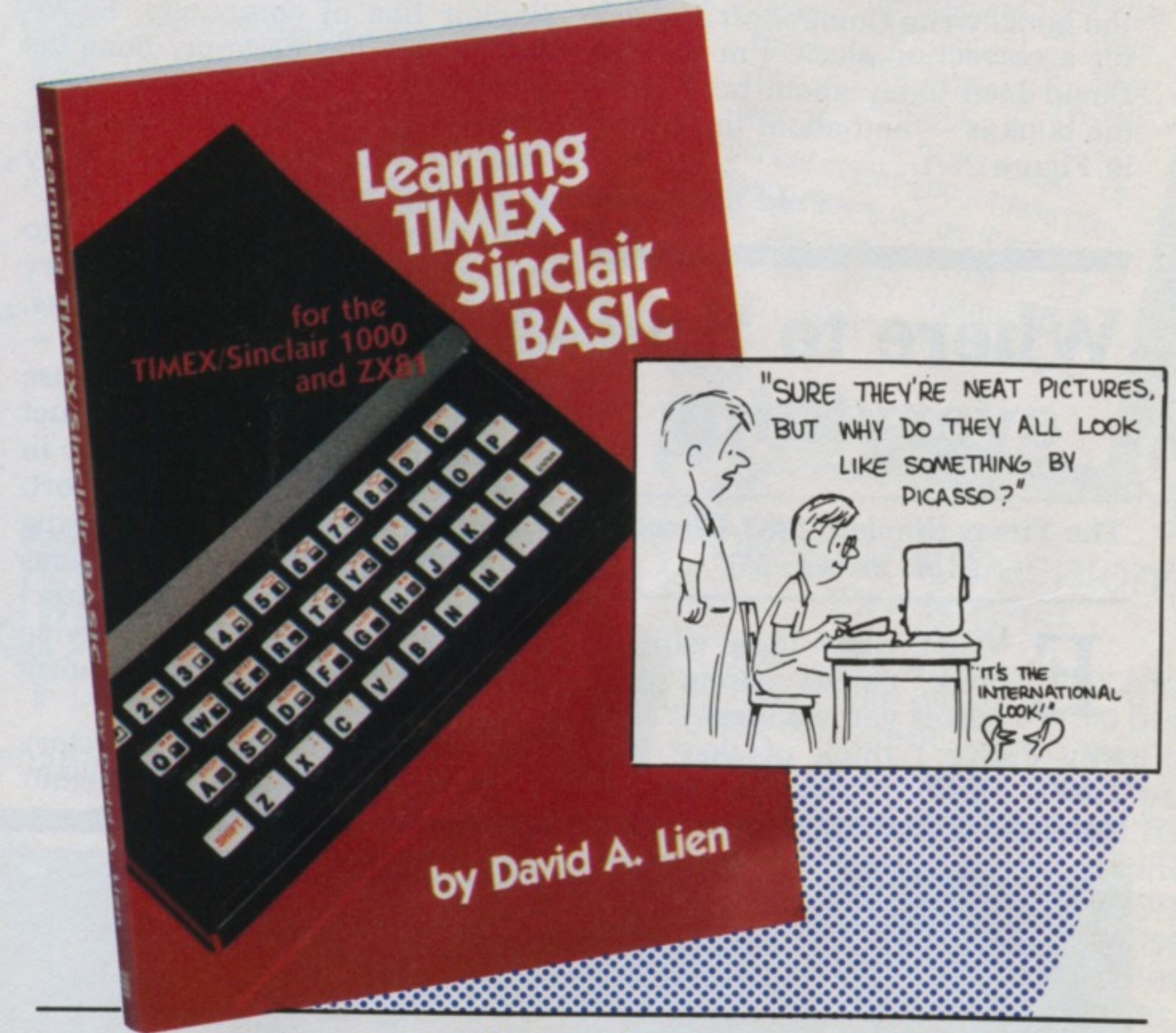
I just received the book yesterday and spent the whole day — and into the late hours — reading. I couldn’t put it down! The beautifully-printed 331-page book is a pleasure to read and use.
This book assumes the reader has no previous knowledge of the BASIC computer language in any version, and goes through the most important commands and statements with numerous examples. The writing is light and breezy, with many cartoons and side-bar comments for emphasis. The actual programming commands and statements are printed in large dot-matrix type to simulate actual display characters and to stand out from the regular text. A whole series of special typeset characters (reverse-video cursors and Timex Sinclair special graphic characters) are used throughout the book to make it absolutely clear which keys are being used, and what the screen should show. Line-by-line explanations of the short programs entered by the user are coupled with the results on the screen, so the reader can correlate the programming with the results, and create his (or her) own variations.
There are four sections to the book. Section A, with 38 chapters, has eight parts: Getting Started, Speak To Me, Strings, Math Functions, Graphics & Display Formatting, Arrays, Miscellaneous and Program Control. Most chapters have exercises at the end to test your understanding and creativity, so this book could easily be used as a classroom text. Section B has the Answers to the Exercises. Section C has some examples of interesting and practical programs ready for the reader to type in and use. Section D is composed of three appendices: The Character Set, Error Report Codes and a four-page Index.
Unfortunately, the manuals that are furnished with the T/S1000, ZX81 computers are so detailed that they are intimidating, and it’s hard to penetrate the details to get an overview. This book could be used in place of the Timex or Sinclair Users Manuals for those wishing to learn the most important features of Timex Sinclair BASIC. Most beginners will find more than enough here to keep them interested and excited, and for those with the thirst for more detail, there are always the very complete (but sometimes hard to follow) manuals that come with the computer.
As with any first edition, there are some goofs. I noted two that would cause a beginner some problems. The first was the answer to the first exercise; it shows the line number as 0 instead of 50. The second was much more serious. A very important full-page layout of screen coordinates is terribly wrong in several ways, and could only cause great confusion to a reader depending on it for explanation of the text dealing with screen formatting and graphics. What are the errors? If you don’t get the book, it doesn’t matter. If you do get the book, write CompuSoft and ask for a correction sheet. I’m writing David Lien today about how great the book is — and about the errors in Figure 25-1.