
This TS 1000 game requires the input of 20 numbers ranging from 1 to 10. The input is rather slow so give the counter time to act. In the graphics the M may be a problem to decipher. All of the letters are 5 characters high by 3 characteers wide except the M which is 5 characters wide. To help out, the first row of M is Graphic Space, G W, Sp G Q, G Sp, and the second row is G Sp G 2, G Sp, G 1, G Sp.
For the tank, the gun barrel is 4 characters long and the turret is 3 characters long. Line 300 can be used as guide for locating the graphic characters. Some of the graphic characters did not print properly. All of the tank is solid black except between the 2 wheels which is graphic shifted G.
  10 REM "COMBAT" BY JACK ARMSTRONG
  15 REM MARCH 1983 "THE PLOTTER"
  18 REM ENTER 20 NUMBERS BETWEEN 1 AND 10
  20 LET SCORE=0
  30 FOR J=1 TO 20
  35 GOSUB 1000
  40 PRINT AT 0,0;"ENTER A NUMBER FROM 1 TO 10";AT 1,8;"GO NUMBER ";J
  50 INPUT A
  60 IF A<1 OR A>10 THEN GOTO 50
  70 PRINT AT 10,0;"YOUR NUMBER IS ";A;AT 12,6;"SCORE IS ";SCORE
  80 FOR G=1 TO 4
  90 LET B=INT (RND*10)+1
 100 PRINT AT 3,3;B;" "
 110 IF B=A THEN GOTO 130
 120 NEXT G
 130 IF A=B THEN LET SCORE=SCORE+1
 140 IF A=B THEN PRINT AT 14,6;"WELL DONE"
 150 IF A<>B THEN PRINT AT 14,8;"BAD LUCK"
 160 PRINT AT 12,6;"SCORE IS ";SCORE
 170 IF SCORE=5 THEN GOTO 260
 180 FOR T=1 TO 20
 190 NEXT T
 200 CLS
 210 NEXT J
 220 PRINT "THE GAME IS OVER AND YOU ONLY";
 230 PRINT "SCORED ";SCORE
 240 PRINT "YOUR RATING IS ";SCORE/.05;" PERCENT"
 250 GOTO 290
 260 SCROLL
 280 PRINT "YOU WIN"
 290 SCROLL
 300 PRINT "ANOTHER TRY? PRESS ""RUN"" ""ENTER"""
 310 STOP
1000 LET A$=" \..\..\..\..\::\::\:: \''\::\:: \::\::\::\::\::\::\::\::\::\::\:: \::\::\::\::\::\::\::\::\::\::\::\::\:: \::\::\::\::\::\::\::\::\::\::\::\:: \ '\::\':\|.\|.\|.\|.\|.\':\:'"
1010 LET B$=" \::\::\:: \::\::\:: \::\:. \.:\:: \::\::\:: \.: \::\:. \::\::\:: \:: \:: \:: \:: \::\ '\::\' \:: \:: \:: \:: \:: \:: \:: \:: \:: \:: \:: \:: \::\::\:: \:: \::\:: \:: \:: \:: \:: \:: \:: \:: \:: \:: \:: \:: \:: \::\::\:: \::\::\:: \:: \:: \::\::\:: \:: \:: \:: \::"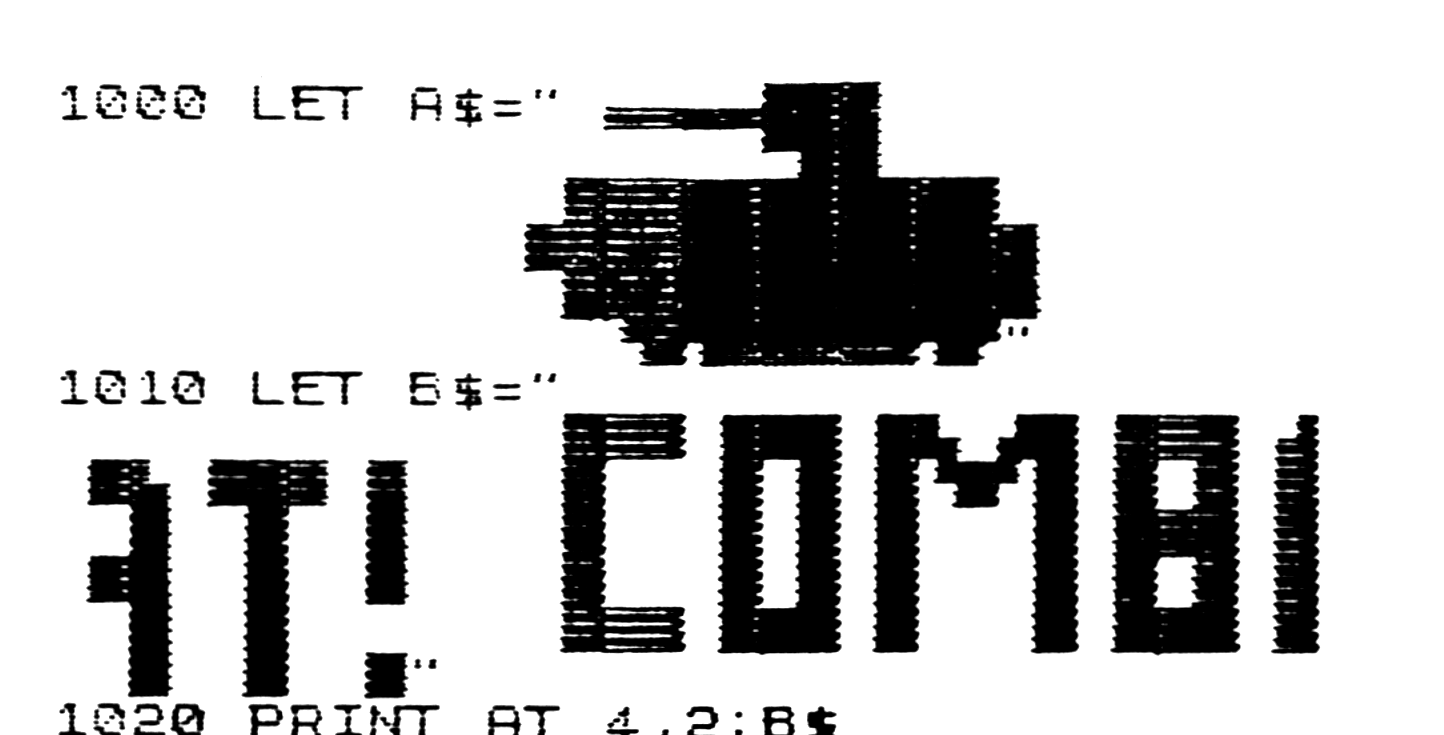
1020 PRINT AT 4,2;B$
1025 PRINT AT 12,9;A$
1030 RETURN
Transcription note: The printer streaks solid areas, so the five cells between the wheels are typed as grey (graphic shifted G, as the article says). The B of B$ in line 1010 prints like a 6. The same graphics were printed in The Plotter v2 n3 (March 1984), with a few cells of A$ and the spacing of B$ different.
Note: Type-in program listings on this website use ZMAKEBAS notation for graphics characters.