
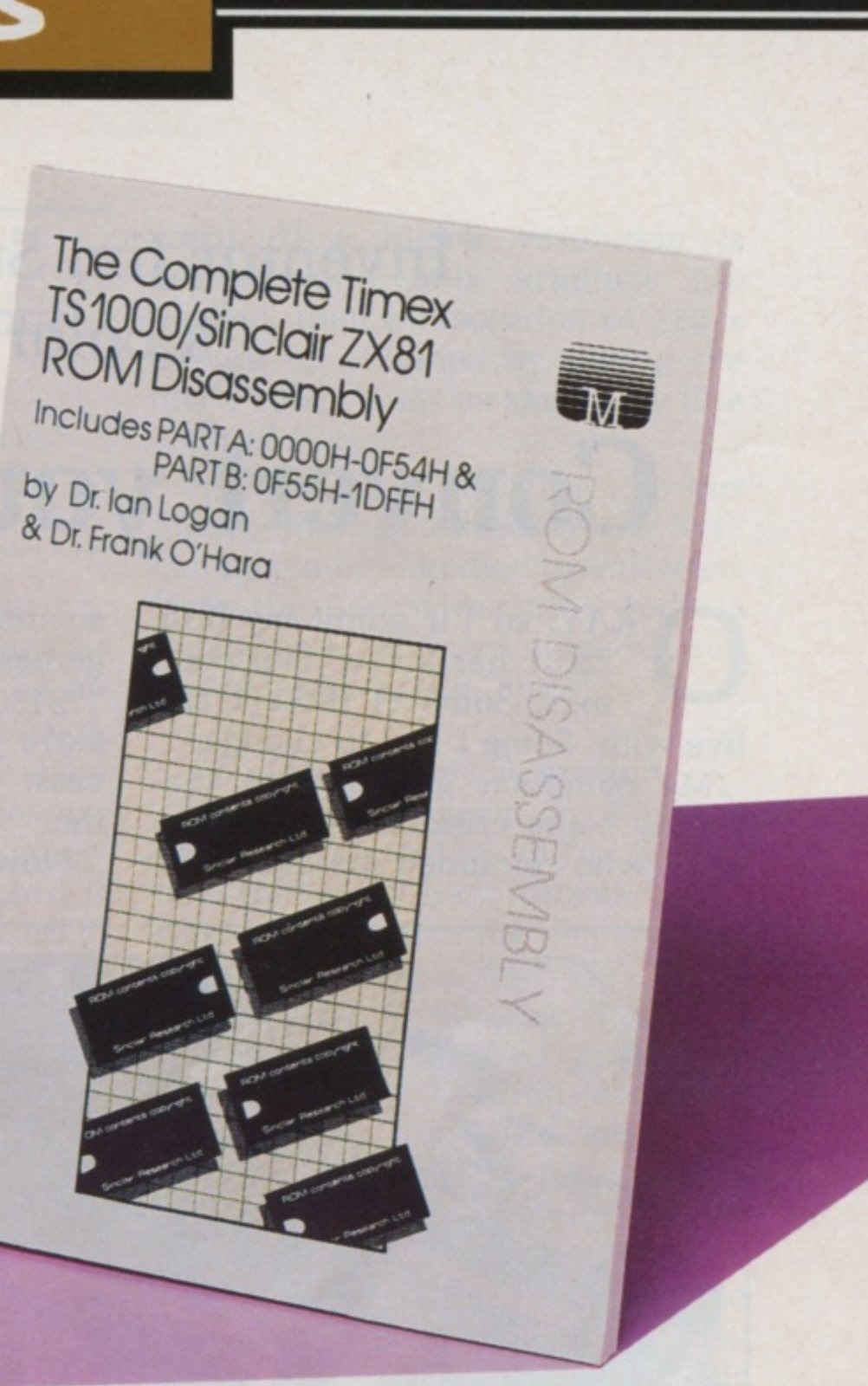
The Complete Timex TS1000/Sinclair ZX81 ROM Disassembly, Parts A & B, by Dr. Ian Logan and Dr. Frank O’Hara (Melbourne House, $19.95)
WHEN Dr. Logan says complete, he means it. This compilation of two volumes (previously sold separately) provides the serious machine code programmer with an annotated disassembly of the monitor program from one end to the other. The first part, up to memory address OF54 (hex), does not have line by line comments as does the second, possibly due to O’Hara’s influence. Though these comments would have been nice in the first part, they are not essential, since the subroutines are generally less complex than those in the second, which deal mainly with floating point mathematical operations.
Both sections, however, have simplified flow-charts and break down the program into individual subroutines that are titled and indexed by the authors. All entries and exits are labeled as well as addressed in hexadecimal. Tables are also included with indicators and comments when necessary. The appendix contains five short BASIC programs that illustrate how SIN, EXP, LN and ATN functions work in the monitor using Chebyshnev polynomials. This might all sound a bit complicated to the beginner, and rightly so, since the book is no piece of cake for advanced programmers either.
The complexity does not come from Logan (who has done an amazing job), but from the original programmers who crammed the program into eight kilobytes of ROM, unconcerned about its readability. As O’Hara indicates at the beginning of Section 2, the feat is doubly amazing considering that Logan did not consult with the Sinclair organization to decode the program. It seems that he reads assembly language like we read magazine articles.
This book is in a class of its own. Many volumes deal with the Z80 microprocessor and assembly language in general, and several relate these directly to the T/S1000,ZX81, sometimes supplying machine code and assembly routines of questionable quality and usability. Books specifically devoted to your computer are usually the most helpful, since you can apply the information concretely. Drs. Logan’s and O’Hara’s work provides hundreds of proven subroutines that you may access directly, recopy and alter in RAM, or simply learn from.
If this book seems difficult to assimilate, it’s because there’s so much to learn from it. If you are a beginner and serious about machine language programming, don’t wait until you are advanced to get this disassembly; you may wait a long time. Since you’ll have to learn assembly sooner or later, why not start with the original program in the Sinclair ROM?