
In the pages of LIST there have appeared designs for decent interfaces using Z80 PIO chips and dip switch settable addressing. There have also been some very convenient specialized versions which do only one thing well.
The lack of a decent source for general purpose interfaces has kept most people from taking full advantage of the features of full size printers, plotters, and other non-TIMEX/sinclair products.
John McMichael has come out with a driver for the COMMODORE printer/ plotter and color printer. My personal congratulations to him.
It is not widely known that the COMMODORE serial port is a simple form of the IEEE-488 GPIB with serial data transfer in place of parallel. It holds no mysterious secrets. What is needed to do the same with a TS2068, SPECTRUM, or QL is a half way decent interface.
Half way decent means that the interface must be program configurable so all the pins on the device to be run (printer or otherwise) are made available as input or output – not just one unique device, but for whatever you want to attach. A single PIO will usually fill the bill.
HORRORS! How can a PIO be used for serial communications? Doesn’t it take a UART or an SIO?
It depends on how fast you want to transfer data. A UART or SIO is very handy if you want your CPU to handle bytes of data. The overhead for testing UART status makes that slower than you might expect.
If you settle for bits instead of bytes, all the popular data transmission protocols become available to you. When you consider that includes Local Area Networking and Mainframe access, you might ask why nobody ever marketed a half way decent I/O interface.
My guess is that people were so disgruntled with the limitations of the TS2068 that they didn’t feel like trying. A few diehards have stayed with it, however. Even so, their efforts have not been exactly welcomed with opened arms so they could make a fair return for their honest sweat.
The answer to this dilemma is to make a series of small, but effective improvements which will not have to be redone later, and not so specialized they don’t allow other uses. A half way decent interface is one of these.
Those who have read some of my previous articles should know that I think the TS2068 is inherently one of the most powerful and fast computers around, even at triple the price. It suffers because of barriers in ROM and bad documentation which have people snowed into believing it was a comedy of errors and mismanagement.
Don’t you believe it!
Replace that accursed ROM and you have a jewel of a machine. SCLD video modes are highly advanced; even better than CGA cards. How come nobody has written any software which takes advantage of it? All I have seen is a couple of pieces of artwork.
A serious suggestion is to get rid of that special connector arrangement in favor of one that is commonly available. Why make everything depend on stacking up device after device that won’t fit anything else? I have suggested that the IBM connector is perfectly suitable, economical, and has the possibility of accepting clone cards. That would make it easier for our favorite computer to stretch its wings. One of those cheap clone cards happens to BE a half way decent parallel port. Why pay more?
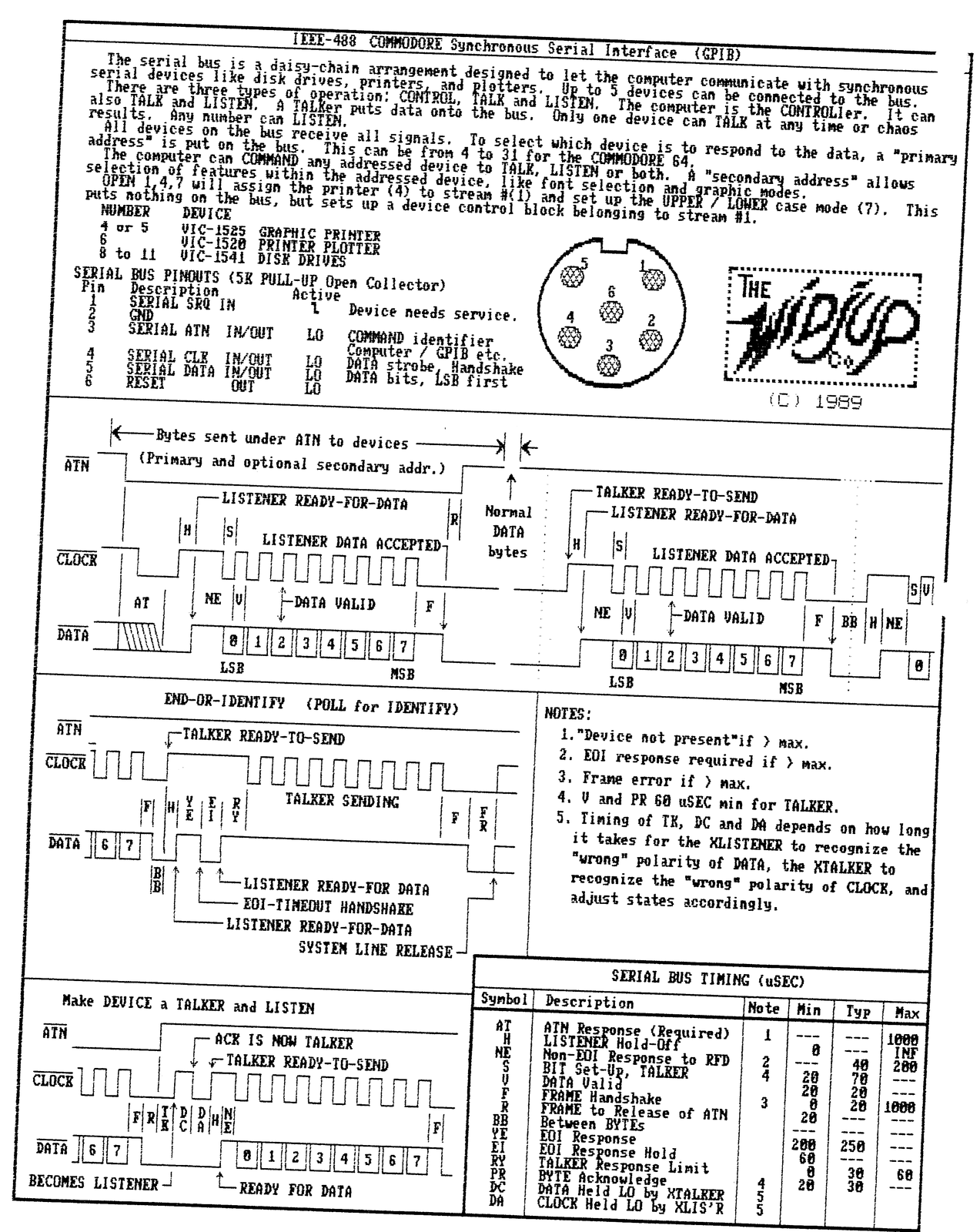
The COMMODORE information shows how six I/O pins from a PIO (or even the joystick port!) can be used to run their disk drives, printer/plotter and graphic printer with your “obsolete” computer. My reason for supplying this information is to get you users out there to get off your duffs and begin to demand (and get) better things made for you. Support your suppliers by being willing to pay what the products are worth – and they WILL be worth it. SOUND OFF! The TS2068 is still in production legally and otherwise around the world. That should tell you something. Everywhere but here? Why?
Show a little support and wonders can happen. Your computer is not just an obsolete toy. Slay those software TROLLS with your support.
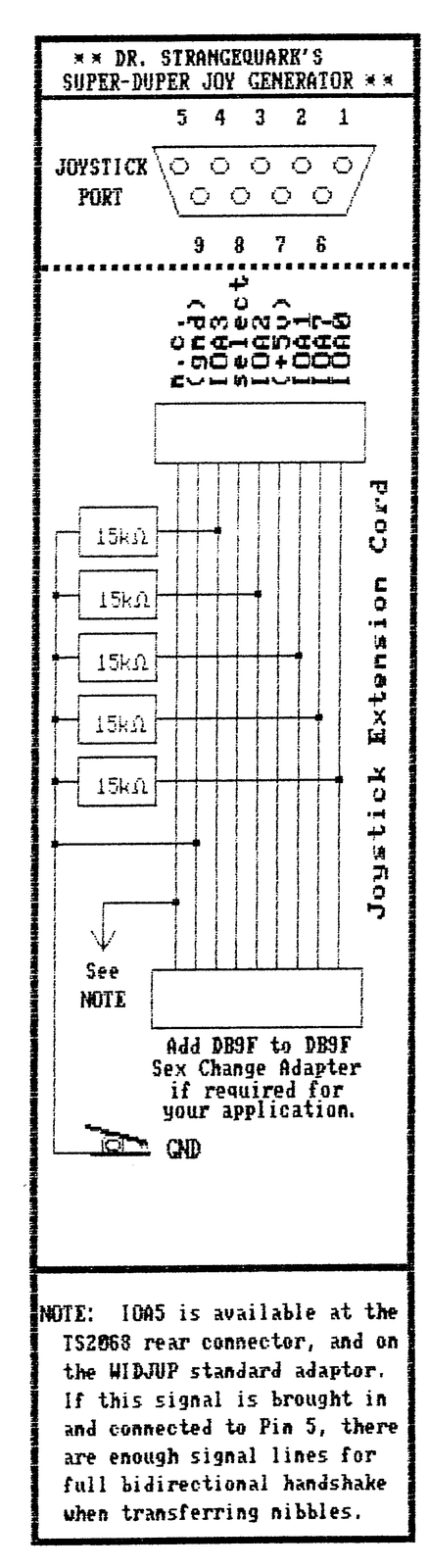
Did you catch that reference to the joystick port? Whether you missed it or not, look for “DR. STRANGEQUARK’S SUPER-DUPER JOY GENERATOR“, coming soon to your local newsletter.
DR. STRANGEQUARK’S SUPER-DUPER JOY GENERATOR
Have you been barking up trees like a hound dawg with its tail between his legs futilely hunting for some WAY for your TS2068 to SPEAK to a ##NEIGHBOR##?.
Is that what’s BUGGING you Bunky?
Well, ##FRIEND##, a !!MARVELOUS CURE!! for your DISSATISFACTION is $$FORTHCOMING$$. Tune in your AUDITORY SENSOR DEVICES & !!LISTEN!!
GET THAT IDIOT OUT OF HERE!!
That’s better. Sigh…..
So — what IS this all about?
When TIMEX released the TS2068, they did a logical thing — for them, but not for us.
In order to prevent using the joystick port (IOA) for OUTPUT to devices that TIMEX didn’t make and others DID, they left off the GND connection.
This barrier is easily bypassed, but first you need to know it was put there on purpose. If you don’t, it is just another example of something that doesn’t work. You’ve been faked out.
When used for joysticks, the port is in the INPUT mode. Signals are pulled down to near GND level by a transistor through pin 6 left, or 6 right. There is no need for a GND pin, which was supposed to be pin 9 both right and left. Diodes prevent one joystick from interfering with the other.
ANY device which can pull signal lines low can be used for INPUT. It need not be a joystick.
When it comes to OUTPUT, the situation is a bit different. Joystick pins can be driven high, but because of the diodes, cannot be driven low. Low IOA port signals cannot get through.
Unless the joystick pins are pulled low by resistors to GND, they cannot be used for OUTPUT. Now where is that GND pin? It figures…..
Can it really be that simple?
Yes. It CAN be and IS.
First, cut a joystick extension cord in half. If you like to be neat, uses a small hunk of perf board to tie down the cut ends and make room for five 15k 1/4W resistors. Jumper all the wires as if they had not been cut. Then wire one end of each resistor to wires from pins 1, 2, 3, 4, & 6. Wire all the other ends to the wire from pin 9 and another 16″ long wire for picking up GND from any other convenient location. Wrap this mess in insulating tape and you nearly have it.
The cable end is the wrong sex to fit the joystick port of another TS2068. You can either use a sex change adapter, or make your cable from two extension cords. The latter is probable the cheaper and better approach.
My preference for picking up the GND is to strip some insulation from the EAR cable and use a small alligator clip on the 16″ wire. You can use any method you wish.
HARK to this ASTOUNDINGLY !!GOOD NEWS!!
Oh, SHADDUP!
The good news is that you now have a fully functional port which can be used for any job which does not require more than five signal pins.
This includes driving the COMMODORE daisy chained serial synchronous interface, for one.
The TS2068 SOUND instruction can be used to drive this interface, or machine code routines can be used. The variety of applications possible is so great that I will leave it up to you eager programmers to have a go at it. One that comes immediately to mind is nibble transfer from one TS2068 to another with handshaking.
Dr. Strangequark
Summary:
A Generic Computer has not yet been offered to the public and may not ever be. A generic computer would provide the standardization needed for direct hook up between computers of the same type or between different kinds to provide additive capability. Two or more computers can be operated as an integrated system by proper interfacing.
The concept runs counter to the special interests of each manufacturer of computers who would like for their product to be exclusive. Because of non-standard buss construction Interfaces must be specially designed.
The big money is in selling whole computers and their needed periphreals. Software Sales for specific types of computers comes next in market potential. Manufacturers are not even slightly interested in developing their products to be capable of co-processing with another brand of computer. The market potential for devices and software to support “two brands of computers” working in an integrated environment is not strong. Thus there are few who will spend the time to work toward interfacing computers.
Many Sinclair users have two or more computers, some as many as a half dozen. We Sinclair users have much to gain by interfacing to gain co-processing capability. Doing that with the QL is the easiest. Interfacing between two different computers is more difficult, but is practical and inexpensive to accomplish.
The following names are mentioned as leaders in the Sinclair User Group who are active in interfacing projects: Larry Kenny (Larken Electroncis), Bill Pederson (WIDJUP), John McMichael, John Oliger, Larmour Crawford, Charles Bothner. I suspect that these entrepreneurs could develop a super capable generic PC computer if we could lock them up together in a garage shop. _BJ-