Back in 1948 Television came into the homes of America. Almost all people thought of TV as an adjunct of RADIO. Radio was THE INDUSTRY, and TV was thought of as a part of it. Of course, TV became its own industry. This bit of history is used to make the point that TELECOMPUTING is destined to become a giant industry of its own. Another illustration: If one looks down upon a ant bed, one sees much activity, but all seem to be going in different unorganized directions. Telecomputing is kinda like that today. Telecomuting is now riding piggy back on two existing industries, Computers and Telephone. But a break-out is about to happen. Amateur Radio Operators are leading the way. Most think of “HAMS” as guys pecking away sending and receiving “di dah dits” and making not so funny interfering lines on TV screens.
But many HAMS now are operating computers and are involved in a form of Telecomputing called PACKET. The principle involved in Packet is the use of Radio and Computers to Communicate. Most of us are aware of Modem Communications with computers via telephone. I became acutely aware when I received a shocking telephone bill a month after getting my modem. PACKET bypasses the telephone, and provides direct computer link up via radio.
NO TELEPHONE BILLS!! But, as with any fledging industry, there are problems, and there are “turf fights”. A&T wants the business and would like to confine Telecomputing to the use of their telephone network. As more computers with modems come on line, local telephone organizations want to develop means of charging for service. The HAMS have a good thing going with Packet, but the Federal Communications Commission regulates Amateur Radio and confines their activities to “Hobby Use”, no commerical operation allowed. Hams can operate with Packet, but ordinary folks who are not licensed radio operators cannot operate Packet. It’s against the law.
During the latter five years of the 1980’s, the Computer population skyrocketed from less than 1% of homes having computers to more than 40% by 1988, and will be up to 80% before 1990. The natural progression is for families to take advantage of the computer’s inherent ability to communicate with the surrounding World. To accomplish this step there must be a breaking out and away from the confines of the telephone industry and the Federal regulation of communications, which is now the most limiting factor. Of course, there must be an organized way to accommodate the tens of millions of people who will be using computers to communicate. Otherwise there would be chaos, everyone trying to communicate, but interfering with each other. This is the next step that must take place between Government and industry planners.
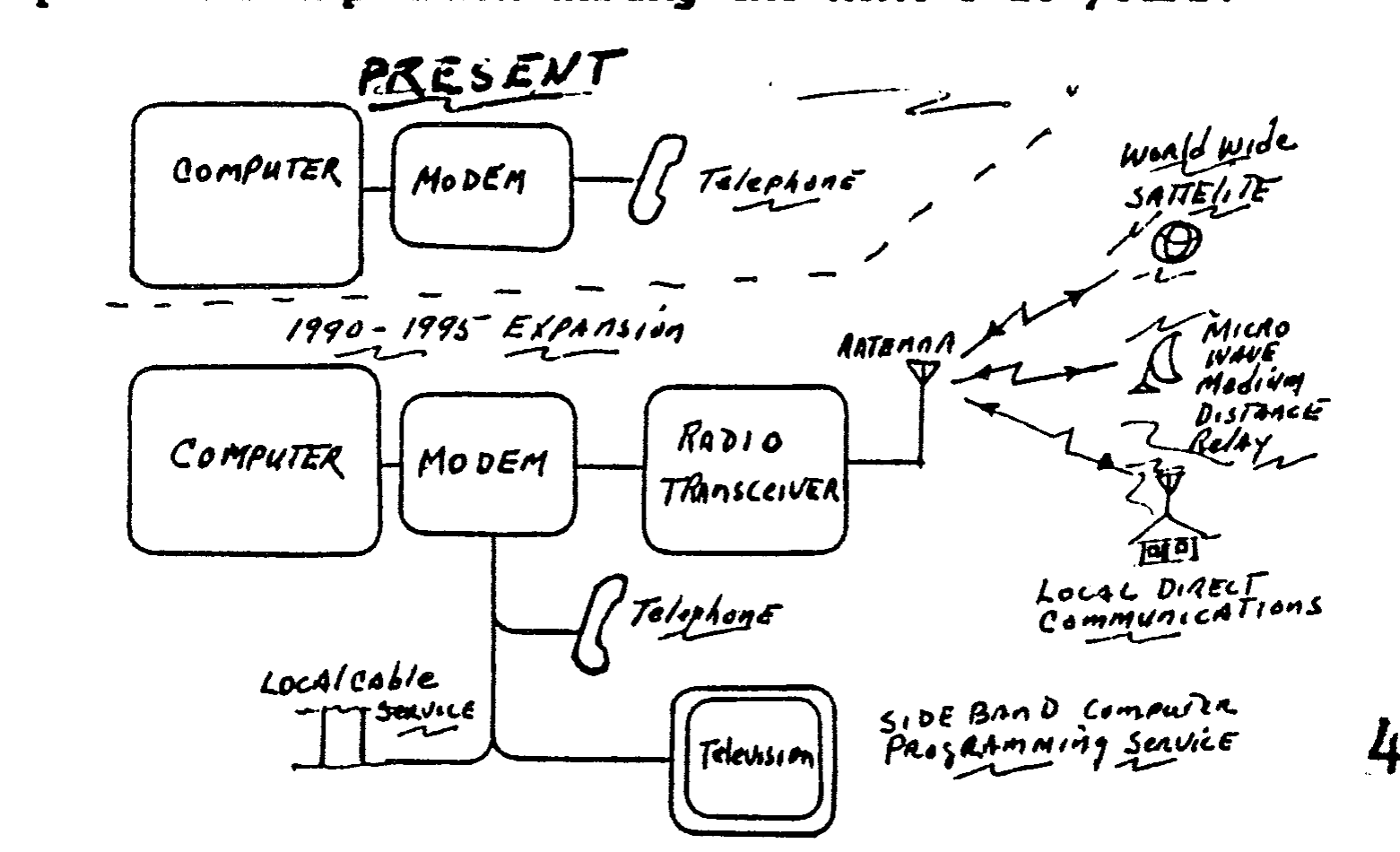
I would invision the decade of the 1990s bringing in a coordinated “starter plan” with Federal regulations licensing telecomputing via satellite, similiar to Packet, plus UHF repeater nets, and local cable service. As the industry builds, and commerical applications expand (profit potential), we will see the Television industry wanting to get into the act, and TV will become a valuable partner to Telecomputing. Each TV channel can accommodate quite a number of discrete side band channels for computer communications without interfering with their regular video programming. One could just subscribe to the service and plug their computer modem into the TV set to receive a daily schedule of services.
In the meantime, awaiting the break through, and the concerted organization needed to thrust telecomputing into tens of millions of homes, a few intrepreneur HAMS are taking the forefront and developing Packet. Bob Diggs is one of these leaders. His letter and article that follow reveal some technical problems being experienced and the level of current telecomputing technology with the Sinclair QL, and all computers as well.. Read between the lines to discern Bob’s personal dedication to the advancement of telecomputing technology. The following sketch depicts where the industry stands at present and the paths for expansion during the next 5-10 years.