
I. The T/S2000 series • II. The T/S1500

TIMEX Computer Corporation last year grabbed what some industry analysts think is the largest market share in home computing with a simple appeal: “the least expensive computer you can buy.” The Timex Sinclair 1000 was essentially a Sinclair ZX81, unaltered since springing from the brow of Uncle Clive.
Appealing as the price was, the machine quickly revealed itself to have several flaws — the membrane keyboard, the RAM pack wobble, the cantankerous cassette storage circuitry — which did not bother the British “nation of tinkerers,” but enraged many of the impatient Americans.
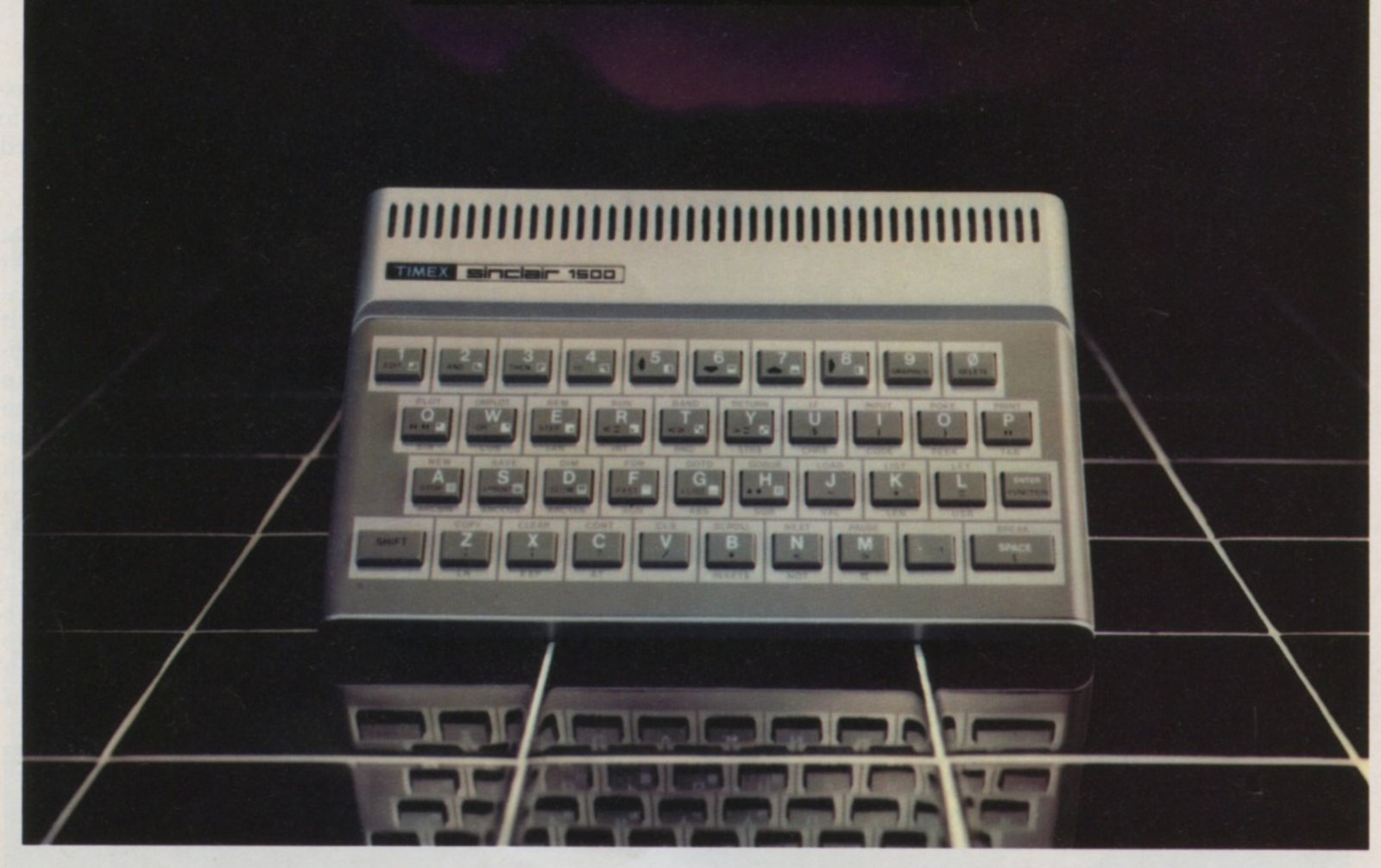
Timex is correcting the 1000, with the redesigned Timex Sinclair 1500. But more importantly, they have learned their lesson and extensively redesigned the Sinclair Spectrum for the American market.
The Timex Sinclair 2000 is a more subtle “sell” than the 1000 was. It is not the least expensive computer. But it is very likely the best inexpensive computer … or the least expensive computer with an impressive array of features.
The machine is indeed impressive. It has a number of features that are easily accessible to the beginning user, and a number of other capabilities — largely added by Timex engineers — which are likely to be used by few home computerists, but whose availability to software developers will result in superb software for entertainment, education, and business applications.
High Tech look
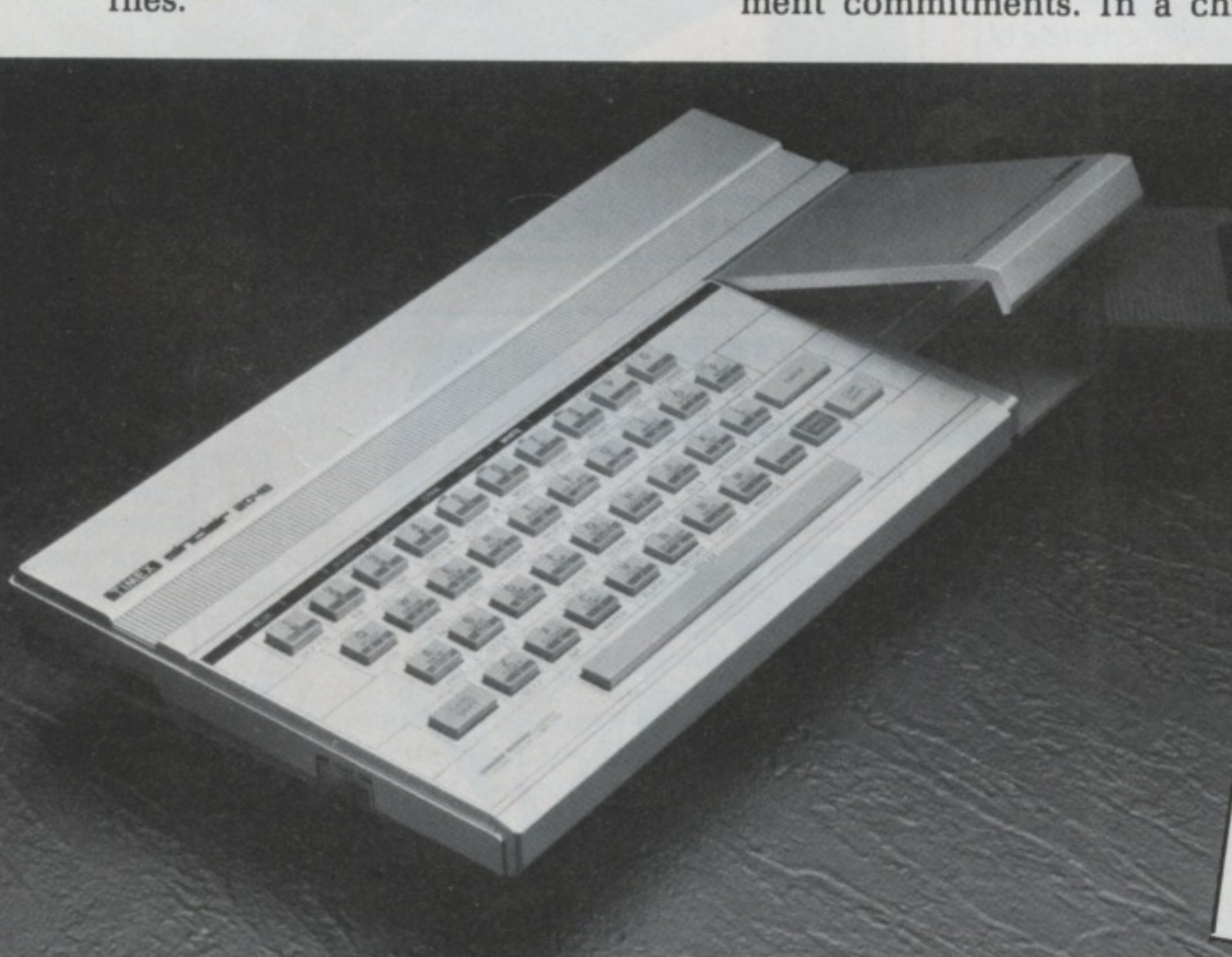
The Timex Sinclair 2000 comes in a sleek silver case, with a high-tech look. The keyboard is full-sized and spaced, although the solid plastic (not rubber ‘chiclet’) keys are not as large as on a normal typewriter — to allow space for the keyboard/function legends above and below the keys. The look is Olivetti rather than IBM.
There is a cartridge port beside the keyboard, with a door or lid over it. Dozens of tiny but powerful Timex Command Cartridges are available, containing software of all kinds.
There are ports for standard Atari-style joysticks on each side (room for two, not one).
There is an on/off switch, a television channel selector switch, cassette input and output ports, a television connection and a separate monitor output, and the unique Sinclair edge connector for peripherals.
Initially, the Timex Sinclair 2040 printer will attach to the edge connector, and a wide variety of expanders and peripherals are sure to follow, from Timex and from third parties.
Bank-switching capability
The 2000 comes with 48K RAM and 24K ROM. Timex points out that some competing machines claim a large amount of RAM but then use it up with programs and housekeeping functions which, in the T/S2000, remain in ROM or in the cartridges. There is even a unique “bank-switching” capability, which allows the machine to address up to 16 megabytes (!) on-line — yes, 16,000,000 bytes. For those who know that an 8-bit Z80 CPU can only address 64K at a time, have faith: the bank switching feature lives with that by switching “chunks” of memory in and out of operation without having to read and write to disk or other off-line storage devices.
There is a full-featured sound and music synthesizer in there, another Timex enhancement. A simple sound command, BEEP, has two parameters, pitch and duration. The SOUND command, which uses the synthesizer, is much more powerful — and complex.
The 2000 comes with eight colors, easily applied independently to the border and to the working area of the screen (the latter called PAPER), and to the items printed on the screen (INK).
The loading and saving circuitry for cassette operation is vastly superior to that of the T/S1000.
Novice-friendly
The beginning computer user will find the single-stroke keywords and functions of Sinclair BASIC easy to use. The T/S2000’s BASIC is a superset of the 1000’s; programs written for the 1000 can be used on the 2000, but cannot be loaded from 1000 tapes.
Software on cassettes or — especially — on cartridges are easy to use without learning programming at all.
Single key commands like BEEP, DRAW, CIRCLE, and the color selection keys allow easy access to powerful functions. There is even a reasonably easy way to design your own graphic symbols.
And a phalanx of pre-publication reviewers have spoken well of the novice-friendly user’s manual, with extensive graphics and color illustrations.
Spectacular programs possible
Advanced features available only in machine code will not be used much by beginners. But when implemented by software designers, they will result in spectacular programs — and some of the software this reporter has seen for the unadorned Spectrum will knock your hat in the creek!
There will be an alternate 64-character screen (for use with monitors but not usually with televisions), besides the standard 32-character display.
A “dual screen mode” will allow for animation by switching instantly between two separate display files.
A high resolution color mode will allow each 1×8 pixel line of a character position to carry its own colors (one INK color and one PAPER color per 8×8 pixel position is standard).
The complexity of the synthesizer chip and its SOUND command, together with the capability of outputting the sound to an amplifier and external speakers, provides for superb music and sound effects.
Marketing a must
Like the T/S1000, this computer is a good beginner’s machine, and also a machine with enough bells and whistles to keep experts happy for years. It has, of course, a much wider range of capabilities than the 1000, and in fact compares favorably with any other machine anywhere near its price range.
The prognosis for the 2000 depends very much on Timex’s marketing and peripheral development commitments. In a chicken-and-egg fashion, the good folks in Norway and Connecticut must invest heavily in marketing — especially consumer advertising — to make this computer a major force in the marketplace … not wait to check its early foot before getting behind it.
And the planned peripherals — many are under development, starting with a much-rumored modem — will have to come quickly.
But at under $200, the Timex Sinclair 2000 has The Right Stuff. I’d buy one.
Who Needs the Timex Sinclair 1500?
SOMEONE recently asked me the following question about the Timex Sinclair 1500: “Who needs a black-and-white machine anymore, with color computers down around $100?
It took weeks to figure out the answer. I believe it is as follows:
1. People who don’t want to tie up the family color television set or drop $300 more for a second set.
2. People who are, on the other hand, willing to spend $80 for the computer and $60 for the television (a b&w portable).
3. People who want a computer to run home “productivity software” — the new buzzword.
When Timex first started producing software for the T/S1000, they avoided game programs — “in black and white, with low resolution graphics, this machine can’t compete with Ataris and the like” — and went in, instead, for business programs: inventory managers, mailing list maintenance, and so on.
Unfortunately, given the unreliable loading and saving, the flat keyboard and the wobbling RAM pack, the machine wasn’t really appropriate for that software either.
But now much of the existing software becomes useful with the T/S1500. My free (and worth every penny) advice is:
1. To Timex: Explore the possibilities of portability. Specifically, link the 1500 with a tiny portable television (assuming Uncle Clive may never get done inventing his flat-screen) and some kind of internal battery power.
2. To software developers, Timex and others: Look hard at expanding the available “productivity software.” With the Memotech printer interface making it possible to use a full-width plain paper printer, a word processing program seems a high priority . . .
Whither the T/S1000?
At this writing, I suspect that Timex has not decided what to do about the 1000 — whether to discontinue it or keep it alive at ridiculously low prices. The likelihood is that they would like to discontinue it once they get the existing inventory out of the warehouse.
It seems likely that this machine — at least the insides, and very possibly the case too — can be “bundled” with peripheral devices and programs in firmware (“wired in” as in ROMs) for specific uses.
I can think of educational packages including the computer along with the programs . . . the T/S1000 as a control device packaged with the home or industrial machinery it controls . . . and other packaging notions similar to the current “calculator in a checkbook” gimmick now being used for credit-card sized calculators.
The T/S1000 has always had an allure for engineers because, in addition to its virtues as an inexpensive, easy-to-use beginner’s computer, it has some additional features:
1. It enables one to do very scientific things, not always easy to do on inexpensive computers (besides the one-key functions, for instance, it is programmable in Z80 machine code).
2. It is a very inexpensive complete Z80-based computer, making it ideal for experimental or classroom use.
The key word “inexpensive” means you need to get past the idea that you will be “wasting” most of its features if you dedicate it to a single task. It still may be the most cost-efficient way of accomplishing that task.
STOP THE PRESS!
As this issue goes to press, we are informed that Timex has changed its marketing strategies. The company now plans to market only the 2072, the 48K version of the 2000-series, which for reasons unknown will be renumbered the 2068. The 2016 is now but a gleam in some designer’s eye.
STOP THE TIMEX MERRY-GO-ROUND (Editorial)
Confusion seems to be the order of the day at Timex. First it squeezed its own machine, the 1000, off the market by prematurely announcing the 2000-series, which had not yet been finalized on paper. Then news of the 1500 was leaked; it came almost as an afterthought — a great machine lost in the welter of misinformation. Rather than receiving an orderly presentation of information from Timex, potential buyers are faced with an unending stream of rumors, leaks, uncertainties and changes. Not a great way to inspire consumer confidence!
We understand Timex is trying very hard to provide a top machine for their customers. We do not understand why a company that is so strong in its marketing of other products can’t devise a logical sales campaign that allows purchasers to make logical decisions.