
Quarters Summer 1985
Date: Summer 1985
See all issues of QuarTerS
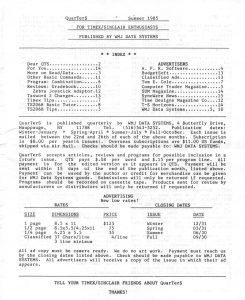
Articles
| Title | Description | Computers |
|---|---|---|
| Combination | Timex/Sinclair 2068, Type-in program | |
| Dear QTS | Timex/Sinclair 1500 | |
| For You... User Groups | ||
| More on Read/Write for the TS1000 | Timex/Sinclair 1000, Type-in program | |
| Other Basic Commands | Tips on converting string manipulation to/from other BASICs. | Timex/Sinclair 1000, Timex/Sinclair 2068 |
| Tasword 2 Changes for Multiple Copies | Timex/Sinclair 2068, Type-in program | |
| Timex Tips | QUESTION: What is the STR$ function used for? ANSWER: The argument (the expression following the keyword) of STR$ must be a number or a variable that stands for a number (like X). The STR$ takes that number and changes it to a string and assigns it to a string variable (like X$). It can now | Timex/Sinclair 2068 |
| TS 2068 Gradebook | Timex/Sinclair 2068 | |
| TS2068 Basic Tutor: SCREEN$ | SCREEN$ is a very useful function on the TS2068 but it has a few limitations that are well known. It has two principal uses. One is to SAVE a screen to tape. This is explained on pages 160 to 161 and appendix A of the manual. From these sources we learn that… The 6912 bytes | Timex/Sinclair 2068 |
| TS2068 Tips | The enclosed hardcopy of my dilemma is rather self explanatory, however just to clarify. Line 10: I want “capacitance” to flash but only until the input is printed. Then it is to remain on the screen in a non-flashing situation. What ever you can do to help would certainly be appreciated. Sincerely, Dave Trevor, Phoenix, | Timex/Sinclair 2068 |
| Zebra Joystick Adaptor | Timex/Sinclair 1000 |