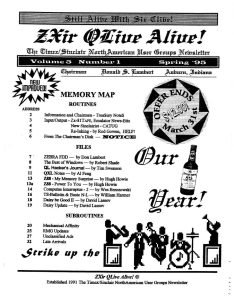
| Computus Interruptus 2 | Response to Part One of this series has been quite gratifying so far. However, from what I’ve heard, it seems that a little “fine tuning” of the format is in order. Essentially, we’ll do fewer things in each installment stretch the series out longer, and give a little more attention to detail. | Timex/Sinclair 2068 |
| Daisy Be Good - II | We continue discussion of Bill Jones’ suite of Word Processors for the TS-2068. So, get out your disk, Daisy.B6, Disk No.1. Upon AUTOSTART, copyrighted banner comes up with a little tune and a request, that you “Press A Key…”. | Timex/Sinclair 2068 |
| Daisy Update | We continue to describe the operations of our new and improved Daisy word processor, using our TS2068, LKDOS (L3), and 9-pin printer Brother M-1109. This time, we talk about the Quickie Menu. Just as the Daisy dB Manager comes up in Bill Jones’ original formulation, only when Turbo = 1 or Turbo = 3 holds, so the Quickie Menu appears only in In+Ed.B6 and ManlAd.B6, respectively. | |
| From the Chairman's Disk | Saw this in an electronic magazine an page 13 of Electronics Now, February 1995 “but can a non-professional really wade through multi-megabytes of code? That is why a number of hobbyists are rediscovering the eight-bit systems and early IBM personal computers. | |
| Input/Output | Letters from Carlos Delhez, Robert Gilbert, Larry Crawford, Rod Gowen, Fred Henn, Gilliam Parrish, Greg Bridgewater. | |
| QL Hacker's Journal | The only key item of news is that as I am writing this the latest version of C68 v 4.2 has partialy come out. I received the zipped version of C68 Runtimes disk #1. Dave Walker should be sending the rest of the disk out soon. | Sinclair QL |
| QXL Notes | MIRACLE SYSTEMS’ QXL is the reality first suggested by the 1986 vaporware named FUTURA. Though the QXL was introduced in North America two years ago, there are many minor points that have not been mentioned elsewhere, and were not covered in the recently released manual (some of this information has already been shared and may yet appear elsewhere). | Sinclair QL |
| TS Bulletin & BASIC N-L | WILLIAM HARMER TS Bulletin Amateur Newsletter — Supplement #A-1994 — Aug.18, 1994 © Aug. 18,1994 by Bill J. Harmer, Ottawa, All rights reserved Times are changing. Woodstock 1994 has just run its muddy course, and the cries of liberation from ‘the system’ that brought the ‘computers to the people’ movement onto the fringes of the | |
| Windows by Shade, Part 2 | Each of the windows is preset by the implementation program to a different mode. The upper left section is set to All Characters, the upper right section to Capitals mode and the bottom section to Numbers mode. | Timex/Sinclair 2068 |
| Z88 - My Memory Surprise | Recently when using my Z88, I was bugged by not being able to save to a file that was already in existence. I also could not erase that file. I could load it, edit it, save it to another title, but not the original title. I was continually being told IN USE. | Cambridge Z88 |
| Z88 - Power to You | I have been reading what various folks have to say about the Z88 Power Supply, and the types of batteries to use, so I thought I would add my little contribution to the discussion, When I first got my Z88, I had to use batteries, so, as I had some Ni-Cad lying around I used them, and I found that they worked fine. | Cambridge Z88 |
| Zebra FDD | The actual dimensions of a 3″ disk are thickness 3/16; width 3 1/8; length 3 29/32 and they come in a hard plastic case which is larger. The 3″ disks are called CF2, whatever that means. To compare the actual size of a 3.5 disk is 1/8 thickness; 3 9/32 wide and 3 9/16 long. | Timex/Sinclair 2068 |